The Making of a Photograph Part 2 – Exploration

In the first post I talked about photographing Yosemite Valley at sunrise from Tunnel View in a snow storm.  I imported the images into Lightroom and reviewed them there.  One stood out.  See The Making of a Photograph Part 1 – Selection.

Yosemite_1

The next step is to explore the image for possibilities.  I do this in Lightroom, making virtual copies of the image that I can then adjust.  I adjust such things as color temperature, exposure, highlights, shadows, fill, contrast, saturation, hue and more.  The goal is to see what’s in the image and what it’s capable of expressing.  I’m also looking for something that gets me excited.

Continue reading “The Making of a Photograph Part 2 – Exploration”

(1084)

The Making of a Photograph Part 1 – Selection

I spent a night in Yosemite Valley a few weeks ago.  See 24 Hours in Yosemite.  It was great to be back; no, it was fantastic to be back.  Both sunset and the following sunrise were shot from Tunnel View, the parking area just as you emerge from the tunnel on state highway 41.  You can always count on company, especially for sunset.

I’m working on one of the photographs taken there that weekend.  But before showing you the image, let’s start with some comments about the light.  Sunset was a near cloudless sky.  The only clouds were a few cotton balls floating over Half Dome.  The rest of the sky was clear.  As the sun set the shadows filled the valley, eventually claiming to the tops of the cliff faces.  But as they did beautiful warm light embraced the the mighty granite but gradually gave way to approaching night.

The morning was quite the opposite.  During the night the anticipated storm rolled in and rain started to fall.  The valley was now full of clouds swirling about, shrouding the eternal granite.  And snow flurries came, keeping all of us at Tunnel View on our toes, protecting our camera gear and warming our fingers.

It was an image from the morning shoot that I selected to work on.  There were long periods of waiting.  The snow flurries passed over us and moved on up the valley obscuring most or all of it.  Then they would pass but the clouds wouldn’t be in the right positions.  Eventually a wonderful, exciting light came shortly after sunrise, imparting a very faint warm cast to some of the clouds.  The rest of the scene was cool, both in light quality and air temperature.
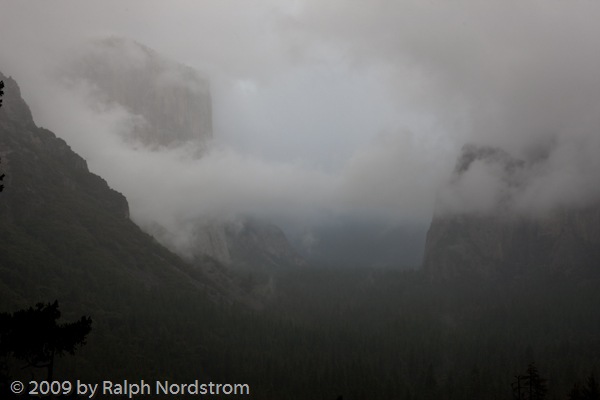
Yosemite_1This is the image I started from as it appears unaltered in Lightroom.  I selected it because of the sense of mystery created by the clouds that just give us glimpses of Bridle Vail Falls and the Cathedral Spires on the right and towering El Capitan on the left.  The hints of the beautiful warm hues in the clouds that I would try to pull from the image are present but not apparent in this image.  Rather, we see the predominantly cool mood.

Over the next several posts I’ll take you through the process of trying to recreate what I saw and felt that morning as well as what I discovered in this image.  There were some wonderful surprises in store.  So stay tuned.

The journey continues – read part 2.

To see more of my photographs click here.

Join me on an upcoming workshop.

Become a fan on Facebook and follow along.

(1096)

Exercising Your Creative Muscle

Describes an exercise to develop your eye for seeing compositions.

Remember when you first started driving?  Just about everything you did behind the wheel was a conscious act – steering into a curve, breaking for a red light, backing out of the garage, whatever.  Everything required a conscious effort.  But now, those things are all automatic and you can safely drive from point A to point B without even once thinking about the physical act of driving.  It’s a part of you.

If you learned to play a musical instrument you went through the same process.  I played piano and at first had to think about every key I pressed.  But as time went by it wasn’t which key needed to be pressed any more but how to interpret the phrase.  The fingers automatically went to where they were supposed to go.

Athletes also experience the same thing.  For example a tennis player at first needs to concentrate on every part of a backhand swing or a serve.  But after a while it it all becomes muscle memory.

The single most important thing that causes this effect to happen is frequent practice, usually daily.

But what does this have to do with photography?  Well, this applies on two levels and I’m specifically referring to photography in the field.  The first is the operation of our instrument, our camera.  At first things such as exposure, focus, depth of field, filtration, etc. are all conscious acts.  And this doesn’t touch on all the additional functionality modern digital cameras provide such as highlight tone priority, high ISO noise reduction and on and on.

Continue reading “Exercising Your Creative Muscle”

(608)

Dawn

I love dawn.  Besides the obvious fact that it’s the start of the day, it’s a way to get the day off to a beautiful start.  If you’re looking for spectacle, sunrises don’t generally compete with sunsets.  During the day the atmosphere gets churned and stirred up by the warming effect of the sun.  Winds kick up dust, human activity creates pollution, all of which contributes to the warm rich colors of sunset.  But during the night the atmosphere cools down and becomes quite,  So that when the sun makes its way around the back side of our planet and is ready to begin its journey across the  sky, the air is clean and calm.  All of this makes for a clarity and purity that is the special realm of dawn.

The general rule of thumb for photographing sunrises is to arrive about 45 minutes early.  By this time all but the  brightest stars have faded and the eastern sky is beginning to glow.  I  prefer to arrive even earlier, up to an hour and a half before sunrise.  At this time I get to marvel at the night sky, enjoy the constellations that are familiar from my childhood and experience the entire progression from night to day.

Continue reading “Dawn”

(527)

Kodachrome Basin State Park, Utah

I took a side trip to Kodachrome Basin State Park this afternoon.  What a cool place.

(c) 2009 by Ralph Nordstrom

The park is famous for it’s columns of cemented sandstone that stretch in come cases hundreds of feet into the air.  Geologists believe that they were once hot springs like those in Yellowstone and that they cooled off and filled with sediment.  Then the earth around them eroded, leaving them standing there.  They call them ‘sand pipes’ and the park has over sixty of them.

(c) 2009 by Ralph Nordstrom

Continue reading “Kodachrome Basin State Park, Utah”

(804)

Arriving after the Light is Gone

Some photographers don’t seem to understand that the good light in the morning is BEFORE the sun comes up, not an hour or two after.

How often do I see people arriving at a great site about the time I’m packing up and heading back?  It happened again this morning.  I was photographing the West Temple and Alter of Sacrifice from half way up the tunnel road.  Granted, I get to a site a little on the early side.  The 45 minutes before sunrise rule gets stretched a little.  I like to arrive while the stars are still out.  Why?  I just like the quite time.

Continue reading “Arriving after the Light is Gone”

(1086)

24 Hours in Yosemite

It had been way too long, too many years, since I was last in Yosemite Valley.  I’ll tell you how long it was.  I didn’t even have a decent camera at the time.  So a chance to spend just one night there was, well, something I was not going to pass up.

It was late Saturday afternoon when we arrived in the valley.  The sky was clear with a few scattered clouds.  My wonder at the immensity of the walls was reawakened as I drove to Curry Village.  There was enough time to check in and make it back to Tunnel View for what was to prove to be a very nice sunset.  It wasn’t one of those million dollar sunsets but nice nevertheless.

Continue reading “24 Hours in Yosemite”

(626)