Archive for January, 2010

Death Valley Workshop for 2010

January 24th, 2010

The Death Valley Workshop is less than a month away – February 20-23, 2010 .  This is shaping up to be a fantastic winter.  The storms that rolled through California last week dropped a half inch of rain in Death Valley.  Now, that may not sound like much until you realize that that is half the annual rainfall and just in one week.  With more storms on the way this is shaping up to be a very exciting winter.

Photographers in the Mud

Last year we also encountered some incredible weather and while we can’t promise a lake in Cotton Balls Basin like the picture above, we can anticipate some exciting photo opportunities.  One never knows that’s in store but the more weather, the better the chances of experiencing something amazing.

Zabriskie Point

But we only have six spaces left.  So if you want to be there this winter with a group of fellow photographers, all passionate about landscape photography, this would be the time.

Check us out.  Click this link for more information.

Death Valley Workshop

You won’t want to miss out.  But remember, there are only six spaces left and when they’re gone, there won’t be any more until next year.  So sign up now.

To see more of my photographs click here.

Become a fan on Facebook and follow along.

Devil's Golf Course

Tags: , , , , ,
Posted in Calendar, Workshops | Comments (0)

Work in Progress – Death Valley

January 20th, 2010

I’m getting excited about the upcoming Death Valley photography workshop.  It’s only a month away.  I thought about the photographs I took last year that I hadn’t quite gotten to and decided to revisit them.

So this week I went back and took a look and am excited about what I found.  These aren’t done yet; they haven’t been printed on paper which is often the most time consuming step in the workflow.  But I would like to share them anyway.

Zabriskie Point is one of my absolute favorite places to photograph in Death Valley.  In the past I’ve always liked sunrise the best.  But this last trip I found some treasures at sunset.  Here are two of them.

_A1P5613 and

_A1P5634

They feel very organic to me and when blown up on my monitor I find them fascinating.  The two have totally different feels to them.  The top on has a soft quality of light while the bottom has a massive, dark presence – dark, powerful but not ominous.  I’m very eager to work with them both on paper and see then matted and framed.

So much of the south end of the valley is dominated by salt that I thought some photographs of the different moods of the salt flats would be interesting.

This first one was taken at midday, not a time we photographers generally have our cameras out.  But what really caught me was the soft ridges with gentle folds that stretch across the center of the image contrasted with the jagged salt formations in the foreground and the chaotic mountains behind.

_A1P5611-Edit

A different mood entirely is the salt flats of Devils Golf Course at sunset on what was otherwise a very cloudy day.  Talk about luck.

_A1P5731_2_3

A photographic visit to Death Valley requires a sunrise or sunset on the Mesquite Flats Dunes.  This was a sunrise and it’s not so much about the dunes as it is about the flats themselves and the Panamint Mountains that frame them to the south west.

_A1P5659

I really like the soft quality of the morning light on these strange formations that are found everywhere throughout the dunes.

Golden Canyon must be one of the most visited places in the Valley, judging from all the cars that spill out of the parking lot and park along the road.  So photographing in Golden Canyon can be challenging because of the masses of people.  Unless you go for sunset on an overcast day and not on a weekend.

One of the things about photographing in overcast conditions is you have the most wonderful open shade light.  And Golden Canyon abounds in little vignette images that are really very rich.

_A1P5867-Edit-2

This is an abstract detail of one of the canyon walls.  And I have more where that one came from.

I’m so excited about these that I couldn’t wait to share them, my Death Valley work in progress.

To see more of my photographs click here.

Join me on an upcoming workshop.

Tags: , , , ,
Posted in Journal | Comments (0)

Color Temperature

January 15th, 2010

I spend a lot of time looking out our kitchen window at dawn, watching the way the light changes (usually sipping a cup of Dragonwell green tea).  It’s fascinating to see how one morning changes from the next.  And the best time of the year to see clear, colorful sunrises (and sunsets) is now – December and January.  The air is the clearest and freshest.

One of the things I really enjoy watching is how the color temperature changes from the time the outside just begins to lighten up until the sun is well overhead.  I’ve discussed this in other posts (Dawn).  What I want to do here is very briefly illustrate the point.

So this evening I grabbed this quick shot with my trusty Canon G11.
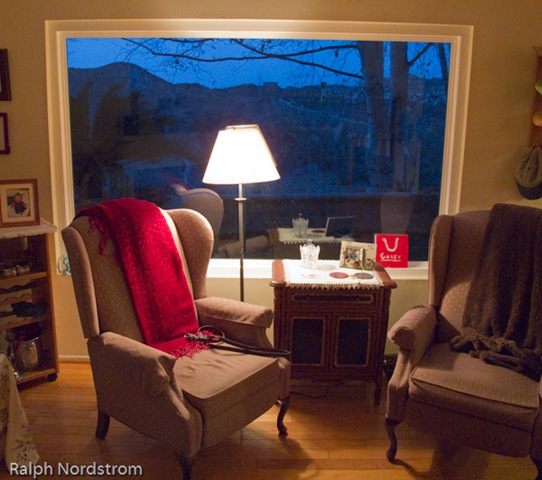
IMG_1030 This is looking out our back window after the sun has gone down (yes, I photograph twilight too). 

You might say it doesn’t look real.  How could the outside be so blue?  But in fact, this is one of those cases where the camera doesn’t lie.  Given that the sun is way below the horizon and the source of illumination outside is the sky, then the light outside is in fact blue.  Inside we have incandescent lights, the color of which is definitely yellow.  The contrast of standing on the inside with warm light and looking out into cool light is both apparent and striking.

Suffice it to say that color temperature is a quantitative measure of the blueness or redness of the ambient light.  Color temperature is measured in degrees Kelvin and the scale goes opposite of what you would expect.  Low temperatures are red and high temperatures are blue (even though we think of reds as warm and blues as cool).  So the color temperature inside the room may be about 4500 degrees and outside it may be 9000 degrees or more.  We’ll get into this in more detail some other time.

As photographers we can use this understanding of color temperature to our advantage.  As digital photographers we always have the option of setting our white balance to compensate for the color temperature – daylight, cloudy, shade, tungsten, etc.

But we can also use this creatively.  We routinely use the warm light of the ‘golden hour,’ the hour after sunrise and before sunset, to give our images a warm glow.  But we can also use the cool light of dusk.

We don’t usually see the colors because our minds are stronger than our eyes and tell us what the color really should be.  But we can train ourselves to pay attention to what our eyes are telling us and actually see the color.

Give it a try.  With a little practice you’ll be able to see the blue in the shadows.  And you just might decide you like it and leave it in your images instead of correcting it out  because it doesn’t look real.

To see more of my photographs click here.

Join me on an upcoming workshop.

Become a fan on Facebook and follow along.

Tags: , , ,
Posted in Articles, How To Articles | Comments (0)

Color Saturation in Lightroom

January 9th, 2010

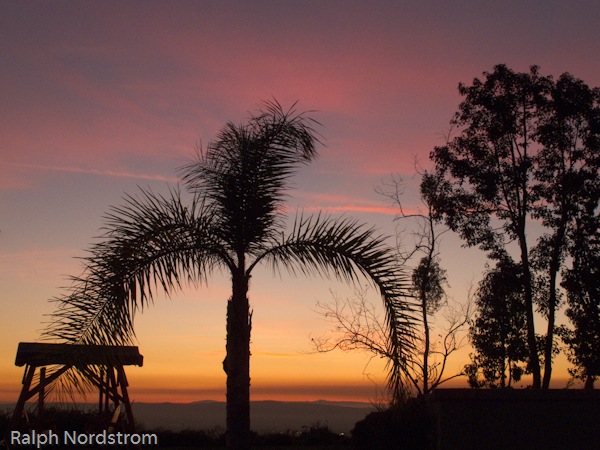
Last night we had a beautiful sunset.  The sky was baby blue, the clouds were pink and the horizon was golden.  I couldn’t resist.  So I grabbed my Canon PowerShot G11 and walked over to the neighbor’s front yard where the view is just a bit better.  I composed what I thought was an interesting image and snapped a few.

This morning I uploaded them and got to wondering about color saturation in Adobe Photoshop Lightroom.  I have a technique I’ve used for years to enhance colors but there are a couple of other techniques I thought I’d like to understand better.  The three Lightroom controls are:

  • Saturation
  • Vibrance
  • HSL (the control I use the most)

So, for starters, here’s the original unadjusted image.

sunset_original As you can see, the colors are really quite nice.  But my recollection of the sunset was that they were a little more saturated, more intense.

Read the rest of this entry »

Tags: , , , ,
Posted in Articles, How To Articles, Lightroom | Comments (1)

Photography Workshop in Fascinating Death Valley

January 5th, 2010

Death Valley has so many fantastic locations to shoot.  But it’s not easy to get great photographs.  It all depends on catching the right light.

That’s where it pays to sign up for our workshop.  We know the valley and can get you to the well known and not so well known locations when the light is at its best.

We’re going next month: February 20 – 23, 2010.  It’s an amazing time of the year. 

Come join us.  You’ll be glad you did.  Sign up by January 15 and take advantage of the 10% early bird discount.  Click on the link below for more information.

2010 Death Valley Workshop

© 2005-2009 by Ralph Nordstrom - All Righs Reserved

Tags: , , , ,
Posted in Workshops | Comments (0)

Ten Tips for Exciting Nighttime Photography

January 2nd, 2010

There is a growing interest in a new kind of nighttime photography.  Photographers have been taking photographs of the nighttime sky ever since film was invented.  These photographs were generally long exposures that show beautiful star trails.  But now they are taking clear, sharp images of the stars and planets literally stopped in their tracks.

Astronomers have always been taking photographs of the nighttime sky and their goal has always been to get sharp images of the stars.  To do that they rigged their powerful telescopes with very precise motor drives that slowly turned the telescopes at the same rate as the stars move overhead, effectively holding the stars motionless in the field of view.

But with the advent of digital cameras the notion of photographing the night sky as part of a broader landscape has become increasingly popular.  And it’s not just star trail images that photographers are capturing.  They are capturing spectacular images of the planets, constellations and even the Milky Way over well known features on earth.  Wally Pacholka is one of the best of this new breed of photographers and his work is an outstanding example of this genre of fine art photography.  Check out Wally’s incredible Top Ten Night Sky Images to see what I’m talking about.

Read the rest of this entry »

Tags: , , , ,
Posted in Articles, How To Articles | Comments (3)