On the Virgin River Bridge at Sunset

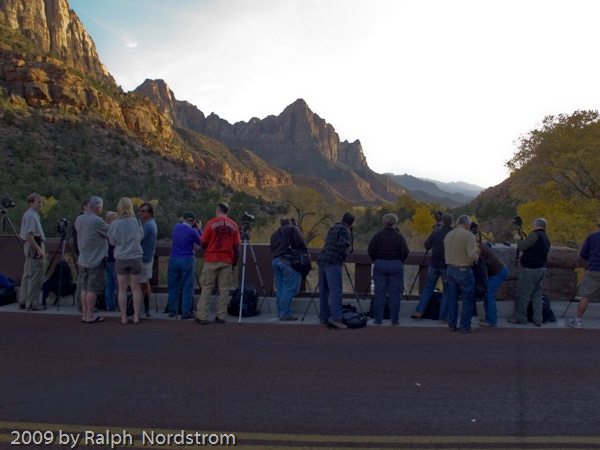
Zion National Park in Southwest Utah has a sundown tradition amongst photographers of all kinds.  We gather on the bridge over the Virgin River in hopes of being there for one of those spectacular sunsets that can only be viewed here.

It doesn’t always happen.  But the ritual continues.  About two hours before sunset we start assembling.  Talk to your fellow photographers and you’ll likely find people from around the world.  Or, someone from your own back yard.

Soon the crowd builds and begins to spread out across the bridge, jockeying for the best locations.  So we tend to bunch up around the premium spots.

(c) 2009 by Ralph Nordstrom

Continue reading “On the Virgin River Bridge at Sunset”

(610)

The Making of a Photograph Part 2 – Exploration

In the first post I talked about photographing Yosemite Valley at sunrise from Tunnel View in a snow storm.  I imported the images into Lightroom and reviewed them there.  One stood out.  See The Making of a Photograph Part 1 – Selection.

Yosemite_1

The next step is to explore the image for possibilities.  I do this in Lightroom, making virtual copies of the image that I can then adjust.  I adjust such things as color temperature, exposure, highlights, shadows, fill, contrast, saturation, hue and more.  The goal is to see what’s in the image and what it’s capable of expressing.  I’m also looking for something that gets me excited.

Continue reading “The Making of a Photograph Part 2 – Exploration”

(1084)

The Making of a Photograph Part 1 – Selection

I spent a night in Yosemite Valley a few weeks ago.  See 24 Hours in Yosemite.  It was great to be back; no, it was fantastic to be back.  Both sunset and the following sunrise were shot from Tunnel View, the parking area just as you emerge from the tunnel on state highway 41.  You can always count on company, especially for sunset.

I’m working on one of the photographs taken there that weekend.  But before showing you the image, let’s start with some comments about the light.  Sunset was a near cloudless sky.  The only clouds were a few cotton balls floating over Half Dome.  The rest of the sky was clear.  As the sun set the shadows filled the valley, eventually claiming to the tops of the cliff faces.  But as they did beautiful warm light embraced the the mighty granite but gradually gave way to approaching night.

The morning was quite the opposite.  During the night the anticipated storm rolled in and rain started to fall.  The valley was now full of clouds swirling about, shrouding the eternal granite.  And snow flurries came, keeping all of us at Tunnel View on our toes, protecting our camera gear and warming our fingers.

It was an image from the morning shoot that I selected to work on.  There were long periods of waiting.  The snow flurries passed over us and moved on up the valley obscuring most or all of it.  Then they would pass but the clouds wouldn’t be in the right positions.  Eventually a wonderful, exciting light came shortly after sunrise, imparting a very faint warm cast to some of the clouds.  The rest of the scene was cool, both in light quality and air temperature.

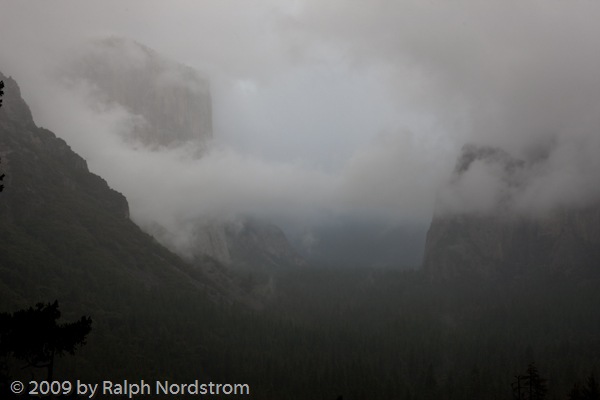
Yosemite_1This is the image I started from as it appears unaltered in Lightroom.  I selected it because of the sense of mystery created by the clouds that just give us glimpses of Bridle Vail Falls and the Cathedral Spires on the right and towering El Capitan on the left.  The hints of the beautiful warm hues in the clouds that I would try to pull from the image are present but not apparent in this image.  Rather, we see the predominantly cool mood.

Over the next several posts I’ll take you through the process of trying to recreate what I saw and felt that morning as well as what I discovered in this image.  There were some wonderful surprises in store.  So stay tuned.

The journey continues – read part 2.

To see more of my photographs click here.

Join me on an upcoming workshop.

Become a fan on Facebook and follow along.

(1096)

Exercising Your Creative Muscle

Describes an exercise to develop your eye for seeing compositions.

Remember when you first started driving?  Just about everything you did behind the wheel was a conscious act – steering into a curve, breaking for a red light, backing out of the garage, whatever.  Everything required a conscious effort.  But now, those things are all automatic and you can safely drive from point A to point B without even once thinking about the physical act of driving.  It’s a part of you.

If you learned to play a musical instrument you went through the same process.  I played piano and at first had to think about every key I pressed.  But as time went by it wasn’t which key needed to be pressed any more but how to interpret the phrase.  The fingers automatically went to where they were supposed to go.

Athletes also experience the same thing.  For example a tennis player at first needs to concentrate on every part of a backhand swing or a serve.  But after a while it it all becomes muscle memory.

The single most important thing that causes this effect to happen is frequent practice, usually daily.

But what does this have to do with photography?  Well, this applies on two levels and I’m specifically referring to photography in the field.  The first is the operation of our instrument, our camera.  At first things such as exposure, focus, depth of field, filtration, etc. are all conscious acts.  And this doesn’t touch on all the additional functionality modern digital cameras provide such as highlight tone priority, high ISO noise reduction and on and on.

Continue reading “Exercising Your Creative Muscle”

(608)

Dawn

I love dawn.  Besides the obvious fact that it’s the start of the day, it’s a way to get the day off to a beautiful start.  If you’re looking for spectacle, sunrises don’t generally compete with sunsets.  During the day the atmosphere gets churned and stirred up by the warming effect of the sun.  Winds kick up dust, human activity creates pollution, all of which contributes to the warm rich colors of sunset.  But during the night the atmosphere cools down and becomes quite,  So that when the sun makes its way around the back side of our planet and is ready to begin its journey across the  sky, the air is clean and calm.  All of this makes for a clarity and purity that is the special realm of dawn.

The general rule of thumb for photographing sunrises is to arrive about 45 minutes early.  By this time all but the  brightest stars have faded and the eastern sky is beginning to glow.  I  prefer to arrive even earlier, up to an hour and a half before sunrise.  At this time I get to marvel at the night sky, enjoy the constellations that are familiar from my childhood and experience the entire progression from night to day.

Continue reading “Dawn”

(527)

Kodachrome Basin State Park, Utah

I took a side trip to Kodachrome Basin State Park this afternoon.  What a cool place.

(c) 2009 by Ralph Nordstrom

The park is famous for it’s columns of cemented sandstone that stretch in come cases hundreds of feet into the air.  Geologists believe that they were once hot springs like those in Yellowstone and that they cooled off and filled with sediment.  Then the earth around them eroded, leaving them standing there.  They call them ‘sand pipes’ and the park has over sixty of them.

(c) 2009 by Ralph Nordstrom

Continue reading “Kodachrome Basin State Park, Utah”

(804)

Arriving after the Light is Gone

Some photographers don’t seem to understand that the good light in the morning is BEFORE the sun comes up, not an hour or two after.

How often do I see people arriving at a great site about the time I’m packing up and heading back?  It happened again this morning.  I was photographing the West Temple and Alter of Sacrifice from half way up the tunnel road.  Granted, I get to a site a little on the early side.  The 45 minutes before sunrise rule gets stretched a little.  I like to arrive while the stars are still out.  Why?  I just like the quite time.

Continue reading “Arriving after the Light is Gone”

(1086)

24 Hours in Yosemite

It had been way too long, too many years, since I was last in Yosemite Valley.  I’ll tell you how long it was.  I didn’t even have a decent camera at the time.  So a chance to spend just one night there was, well, something I was not going to pass up.

It was late Saturday afternoon when we arrived in the valley.  The sky was clear with a few scattered clouds.  My wonder at the immensity of the walls was reawakened as I drove to Curry Village.  There was enough time to check in and make it back to Tunnel View for what was to prove to be a very nice sunset.  It wasn’t one of those million dollar sunsets but nice nevertheless.

Continue reading “24 Hours in Yosemite”

(626)

Starving Artist

I have to share this story with you.  Yesterday I had a booth at the West Mission Art Festival in South Pasadena, California.  I was handling the booth by myself so didn’t duck out for food or drink but relied on what I had in my cooler.  Actually, all I had in my my cooler was drink – a hand full of water bottles and another hand full of iced green tea.

It must have been about 1:00 that a mother and her daughter of about, oh, I’d guess about 14, wandered into my booth.  They were obviously good friends and having a wonderful time together.  The daughter had a plate full of French Fries.  I felt bold so I asked her if I could have one.  She said, “Sure.”  So I took a single French Fry,  It was hot, greasy, salty with a strong taste of garlic.  In other words, it was great.  I couldn’t resist saying to her, “You know what you just did?  You just fed a starving artist.”  They both laughed.

We talked about the photographs and photography and art.  When they were ready to leave the daughter offered me another French Fry which I gladly accepted.

Then I went back to my chair to sit and watch the few people that were at the show wander by, many of them not even turning their heads to take a look.

After about ten minutes the daughter returned and held out her French Fries to me.  “I’ve had enough.  Would you like the rest?” she asked through a smile.  “Why thank you, thank you very much.  You are so nice!” I responded as I accepted her gift.  He handed me her French Fries and disappeared to rejoin her mother.

I sat back down in my chair, turned my attention to lunch and forgot about the occasional person that wandered by my booth without looking in.  The hot, greasy, salty, garlicky fries tasted even better with the generous dusting of kindness.

Visit me on http://ralphnordstromphotography.com/

Also, become a Facebook fan.  Click here.

Join us for a photography workshop.  Click here for more information.

(309)

A New Lightroom Technique

Explains a Lightroom technique for dealing with difficult lighting conditions, especially with those associated with dawn and twilight.

I love the time in the morning when the eastern sky just begins to show the first hint of the dawn.  The world goes through an amazing transformation up until the sun peeks over the horizon and begins its march across the sky.

My camera and I are very active during that time but I have precious little to show for all the gigabytes of images we’ve captured.  That’s not to say I haven’t tried really hard.  But none have turned out to my satisfaction.  They all seem so heavy-handed and certainly don’t capture the serenity of the moment.

Well, I had an idea today.  It goes back to something I experimented with a couple of years ago and couldn’t get to work.  The basic idea is to work in black and white first and later restore the color.  The thought behind this is to get the tonalities right first without the distraction of color.

What I am about to describe is done in Lightroom and doesn’t use any of the local adjustment features of LR 2.

So, my first approach was to set the image to Grayscale in the Treatment area of the Basic control group in LR.  I wasn’t after anything fancy here, just to get the image into BW.  Next I adjusted tonality – black point, white point, contrast, etc.  In this step I was after a good looking BW image.  Next, back in the Treatment area I set the image back to color.  What I found was the color image was WAY over saturated.  Later I learned that was because I was working in RGB and not Lab.  So I tried Lab but never really got the hang if it.

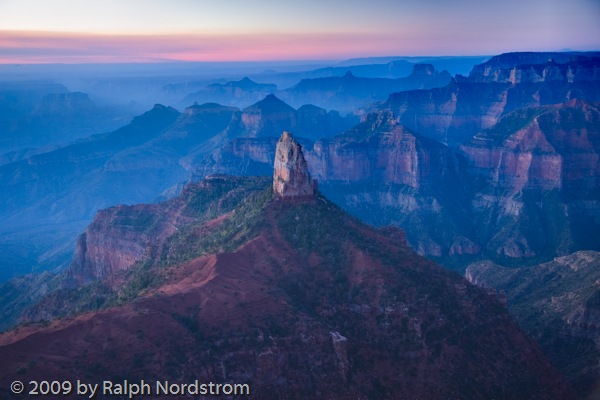
Then today I had an idea.  I was working on an early morning photo from last month’s Grand Canyon trip and wasn’t happy with the way this one was turning out either.  So I fired up LR again and selected the image I had been working on.  Let me walk you through the process.  It’s the same idea but executed in a much more controlled manner.

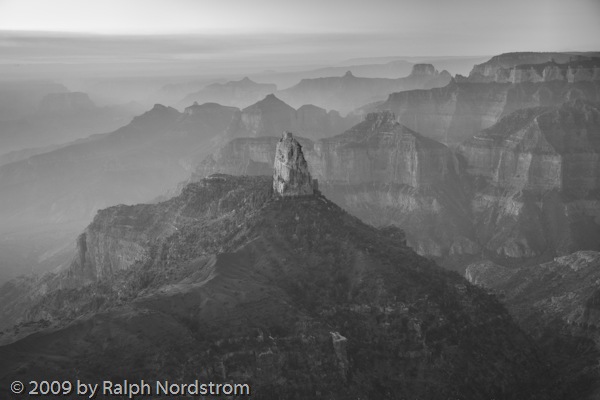
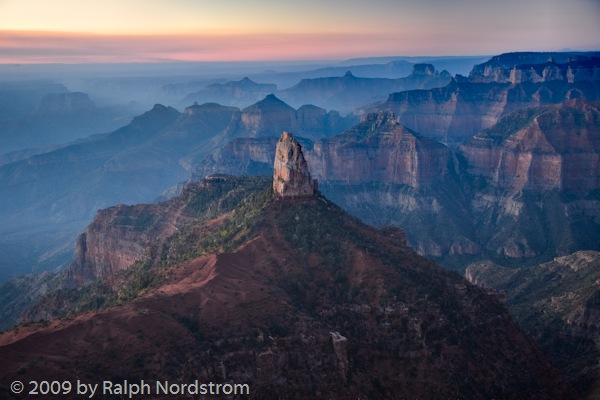
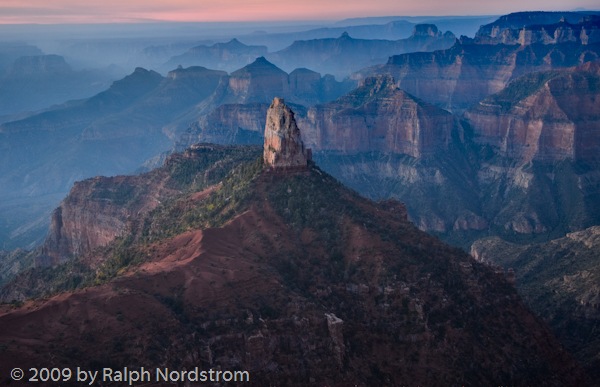
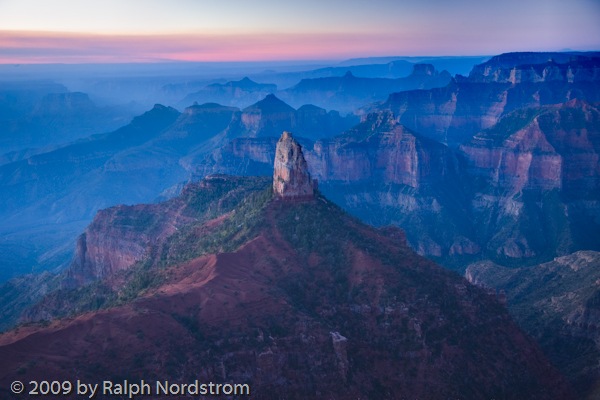
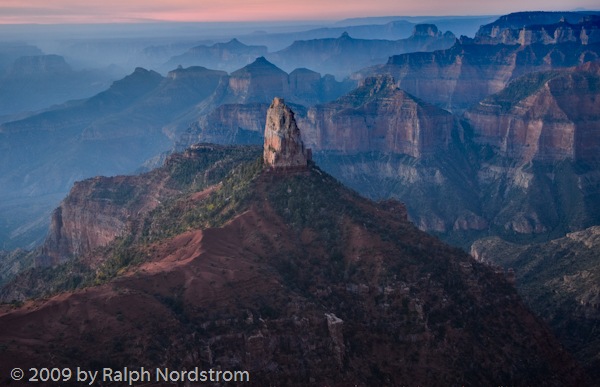
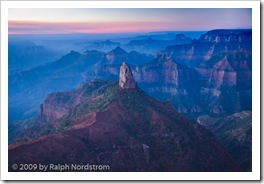
Here’s the starting image.  Actually, due to the extreme dynamic range, this is an HDR image.  But this was the starting point.  There’s lots of atmosphere in this image.  And a lot of blue.  You would expect it to be cool because the main source of light is the blue sky.  I like the sense of atmosphere but I’d like to moderate the blue, bring some warmth into the rocks and maybe a little more definition to the cliffs in the middle ground. _A1P1372_0_1_fused-1 The first step is to render the image to black and white.  But instead of using the Grayscale feature, I turned to the HSL control.  You can render colors in gray scale by reducing their saturation.  So I selected Saturation and set the slider for each color to zero.  The result is a BW image.
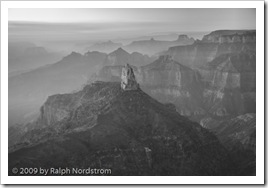
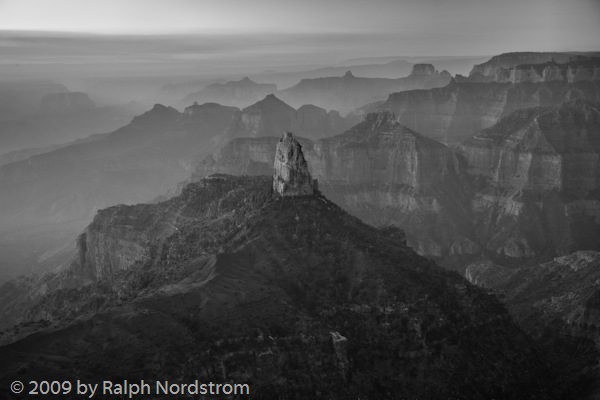
_A1P1372_0_1_fused-2 It looks good this way.  There is still lots of atmosphere in the distant haze.  But I’d like to try to get a little more contrast in the middle ground cliffs without loosing the hazy feeling.  And I’d like to open up the dark area in the center and bottom a bit.  A little playing around with the Basic controls yielded the  following.
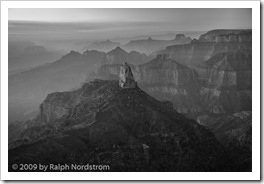
_A1P1372_0_1_fused-3 In this example the differences are pretty subtle but can be seen when you enlarge the two images.

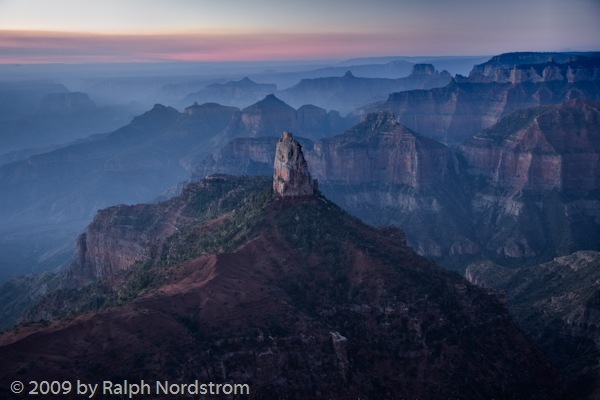
The next step is to reintroduce color by increasing the saturation one color at a time.  The nice thing about this process is that it turns out to be easier to add color than to try to take it away.  You can always add a little of one color, them some of another and jump back and forth until you get close to the effect you want.  So after a few minutes this is what emerged.
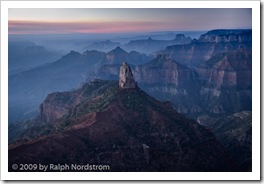
_A1P1372_0_1_fused-4The image is still cool but it’s not the overwhelming blue of the original.  The foreground has a lot more detail and is much more to my liking.  The middle ground has a bit more definition because of the adjustments in the tonality we made in the last step and the reduced intensity of the blue.

But it’s still too blue.  The image would be strengthened if there were some contrasting colors.  It doesn’t have to slap you in the face; there just needs to be some soft oranges and yellows to complement the blues.  This will add a lot of visual interest to the image.  To do that I turned to Color Temperature.  Increasing the color temperature (shifting the color balance to the yellow) produced this image.
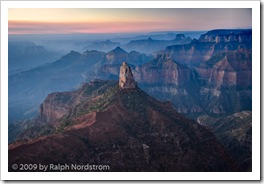
_A1P1372_0_1_fused-5This change produced a very pleasant surprise.  By adding yellow the spire in the center of he picture separated itself from the blue background and the image became much  more three dimensional.  The effect is subtle but very real.

One final change is needed.  The sky in the upper left hand corner is very close to being blown out and very distracting.  I tried several things to darken it, desaturate it and the like.  I considered waiting until I got the image into Photoshop to deal with it.  But then I decided to crop it out.  The sky isn’t needed to make this image work.  It’s really the rows of receding ridges reaching above the blue haze that gives this image its impact.  So out came the crop tool.
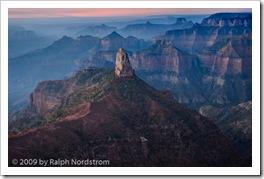
_A1P1372_0_1_fused-6 This is much more pleasant than what I’ve been able to come up with over the past several weeks.  I’ll sleep on this and return to it another day.  I find that I get caught up in what I’m trying to do and when I see it a day or two later I often wonder what I was thinking.  So there may be some more adjustments in Lightroom but it’s very close to being ready to import into Photoshop for the fine tuning.

To make the before and after comparison easier, here they are side-by-side.

_A1P1372_0_1_fused-1 _A1P1372_0_1_fused-6

We conduct photography workshops.  Click here to check them  out.

To see more of my work visit http://RalphNordstromPhotography.com

Finally, we invite you to join us on Facebook and become a fan.

(671)