Why HDR?

Many photographers think HDR is a bad thing and avoid it like the plague. But it’s harmless and can be useful. Read on….

Why HDR?

For many photographers, the term HDR is associated with a style of photography that is rather absurd – the grunge look.  I’ve heard experienced photographers say they don’t use HDR because they don’t like the results.  When the beta version of Photomatix, a product created by HDRsoft, made its debut on November 20, 2008, it automated a manual process that landscape photographers were using at the time.  Occasionally, they would encounter situations where the dynamic range of the scene they wanted to photograph was greater than what the dynamic range their camera’s sensor could capture.  So, they took two shots at different exposures that, when put together, covered the whole dynamic range of the scene.  Then they stacked the two images in Photoshop and created masks to expose the highlights from the underexposed image and the shadows from the overexposed image.  The final result was an image that captured the full dynamic range of the scene.  Photomatix simplified this process by doing the blending.  But instead of blending just two images Photomatix could blend three, four or even five images.

Photomatix also gave the photographer a choice on several different ways of blending the images.  Grunge was just one of them and it took off like wildfire.  There were a few grunge photos that were excellent, but most were mediocre at best.  For many people, HDR became associated with the grunge look which gave it its bad name, and it became poor taste to shoot HDR.

But dealing with dynamic ranges in a scene that exceeds the technologies of the day wasn’t new.  It goes back to the beginning of photography in the 1860s.  After all, all cameras so far have a limit to the dynamic range they can capture whether they use Daguerreotypes, wet plates, dry plates, film or digital.

Continue reading “Why HDR?”

(114)

“What Was He Thinking?”

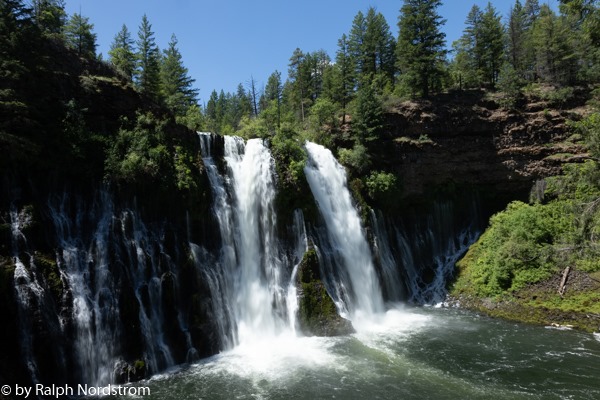
Capturing the essence of Burney Falls. Turning what the camera saw into what the photographer saw.

Burney Falls

“What was he thinking? What kind of picture is that? It’s not very good.”

I had heard about Burney Falls at MacArthur-Burney Falls Memorial State Park for some time. It sounded intriguing. Located in Shasta County in Northern California I wanted to see what Teddy Roosevelt called “the Eighth Wonder of the World.” Continue reading ““What Was He Thinking?””

(425)

Photographing Death Valley National Park

Enjoy some of the photographic wonders of Death Valley National Park on an exciting photography workshop.

People sometimes ask me if there’s anything to photograph in Death Valley.  At 5,262 square miles of desert and mountains, it’s one of the largest national parks.  The valley itself is 140 miles long.  Think of it.  It takes three hours to drive from one end to the other.  And surely, in all that space there should be something to photograph.  And yet, most of it is desert.  In fact, the valley itself is the hottest, driest place on earth. It’s also the lowest spot in North America at 282 feet below sea level.  So what’s to photograph?

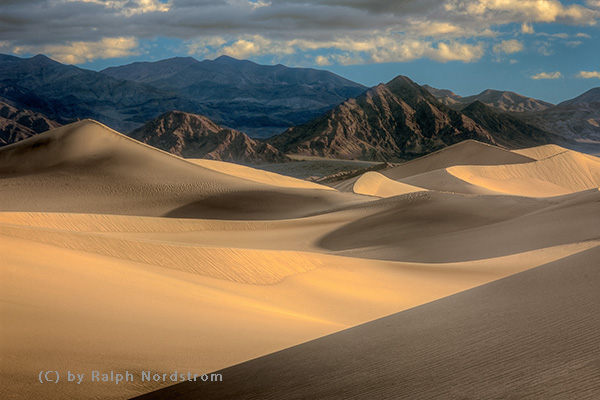
Mesquite Flats Dunes

Death valley dunes 2011

Being a desert you might expect sand dunes and you would be right.  The Mesquite Flats Dunes are in the middle of the valley near Stovepipe Wells.  While not excessively high, they cover a large area and provide wonderful photographic opportunities at both sunrise and sunset.  I prefer sunrise which means heading out across the desert while it’s still dark to arrive at the dunes just as it’s starting to get light.  I go to a place that’s not heavily visited.  It’s an exciting experience.

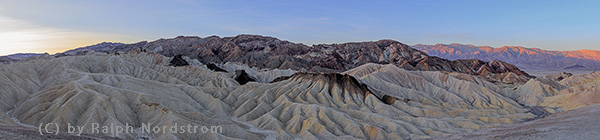
Zabriskie Point

Zabriskie point pano 140211

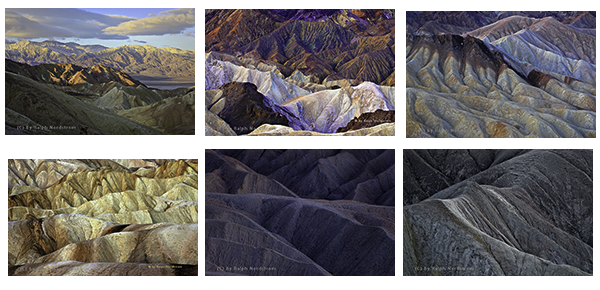
Zabriskie Point is one of the most visited places in Death Valley.  It attracts photographers and tourists alike.  At first it looks like an inhospitable badlands with not much to offer the photographer except a lot of tan wilderness.  But at the right time of day these ‘bad’ lands become extraordinarily beautiful.

Zabriskie collage

It’s all a matter of being there at the right time.

Continue reading “Photographing Death Valley National Park”

(333)