Eastern Sierra Photographs

I finally got a chance to work on a few more Eastern Sierra workshop photographs from June.  It’s amazing how many things barge to the front of the line.  But I finally got to these.  I hope you enjoy them.

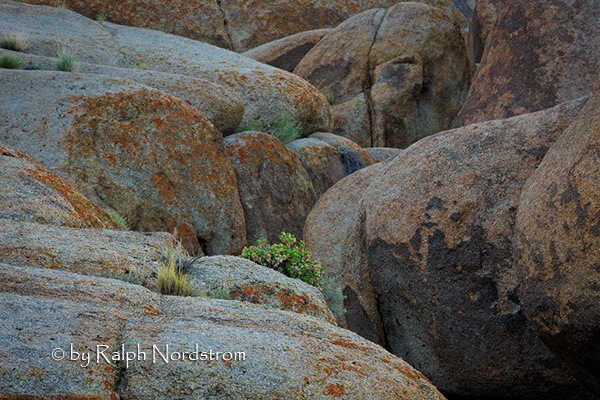
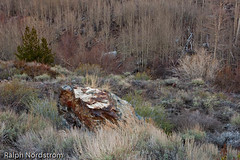
alabama_hills_vignette_2010Alabama Hills Vignette

This one was taken before the workshop started.  It’s just one more wonder to be found in the Alabama Hills.  I get a very quite feeling from this one.

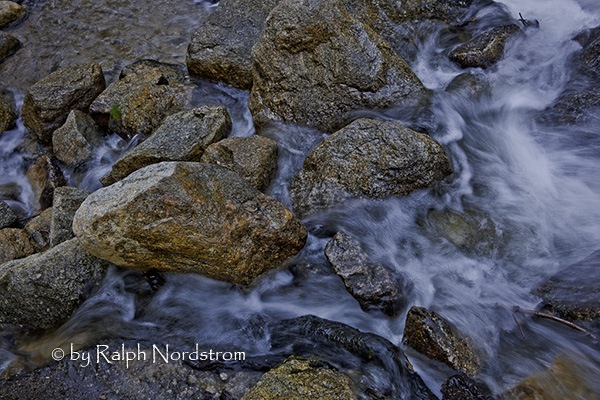
lone_pine_creek_2_2010 Lone Pine Creek 2

One of the exercises we did during the workshop was to photograph the chapter, paragraph and sentence on Lone Pine Creek at Whitney Portal.  This was my sentence photograph.  The water is swirling around the rocks going every which way.  This image captures the whole turbulence of the cascade in this little microcosm.

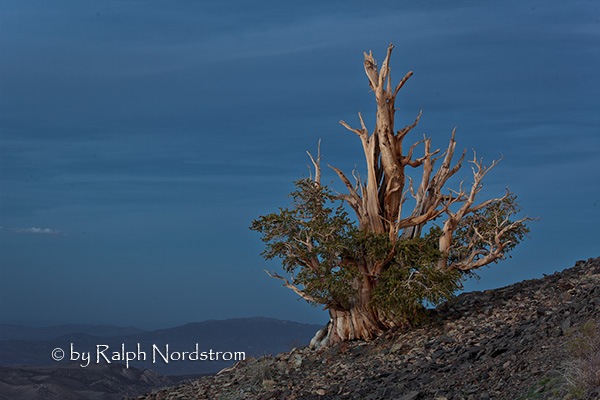
bristlecone_dusk_2010 Bristlecone Dusk

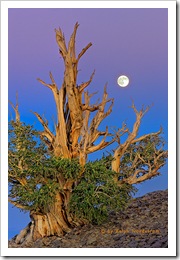
I keep coming back to this bristlecone pine in the White Mountains.  And each year the interpretation is different.  It was somewhat overcast this year and as night was coming on the clouds created subtle patterns in the sky.  One of the things I like about this tree is how it grows high above Great Basin.  It’s been here for thousands of years.  On this evening it softly glows as the day turns to night – one more time.

half_dome_storm_2010 Half Dome Storm

The Tioga Pass road opened just a few days before we arrived in Lee Vining.  So there was no doubt that we would photograph sunset in Yosemite.  Olmsted Point provides a unique view of Half Dome from the back side.  As luck would have it a storm was rolling across the Sierra and we were there.  I love the power in this photograph.  When I look at the image I can’t help thinking how good it would look in a Southern California arts and crafts style house.

These will be up on my website soon but I wanted to give you a preview.

Join me on an upcoming workshop.

To see more of my photographs click here.

(690)

Honesty in Photography

I just read a great email from Brian Peterson, founder of The Perfect Picture School of Photography.  He ran an unscientific opinion pole on whether photographers felt it was OK to dramatically alter photographs in Photoshop.  Now, by ‘dramatically alter,’ Brian means to add major elements to an image that were not present in the original scene or make other major changes that alter the content of the image.

He has a provocative blog post with the title that starts, “Every photograph is a ‘lie,…’,  In it he raises the excellent point that even those photographs that aren’t altered in Photoshop are still an abstraction of reality and thus a ‘lie.’  I recommend you read it.

What were the results of his opinion pole?  Brian reports that 41% of photographers felt that it is OK to dramatically alter images in Photoshop and NOT tell anyone unless asked.  And if asked, some would say, “It’s none of your business.”  The reason photographers felt this way boiled down to two words – Artistic License.

I have my own thoughts on “artistic license” and would like to share them with you.

Continue reading “Honesty in Photography”

(1497)

Bishop Creek Spring


_A1P5434

Originally uploaded by Ralph Nordstrom

Here is one of the photos I took today along the South Fork of Bishop Creek. South Lake was still snowed in but down the canyon spring was marching up. You can view the rest of the photos I took today on Flickr.

(280)

zabriskie_point_7_2009_600

I thought I knew where I wanted this image to go but it had a mind of its own – beyond realism, beyond believability even, into pure emotion.

(416)

Principles of Composition – Chaos

“… nature – unadulterated and unimproved by man – is simply chaos.” Edward Weston.

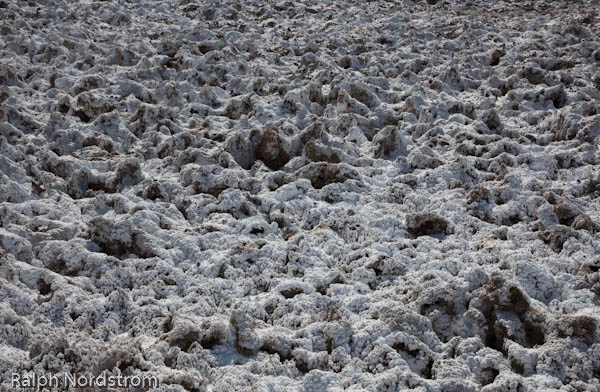
There’s no argument that Edward Weston was one of the finest photographers that ever tripped a shutter.  And one of the aspects of his photography that he is most revered for is his compositions.  He was the absolute master in his studio but when it came to photographing nature he admitted that it was the most difficult of all.  Why?  Because nature is chaos.

Nature is Chaos - Death Valley National Park Nature is Chaos

Continue reading “Principles of Composition – Chaos”

(1936)

Why You Should Consider Taking a Photography Workshop

Reasons for takikng a photographic workshop and what to look for to get the most out of one.

Do you love photography?  Is it a passion within you?  Are you inspired by nature?  Do you want to get out to some great locations and come back with some stunning photographs?  Do you want to become a better photographer?

If you answered ‘Yes’ to any of these questions, than you should consider taking a photography workshop (or another workshop if you’ve already started down that path).

What Makes for a Good Workshop?

What are the reasons for taking a photography workshop?

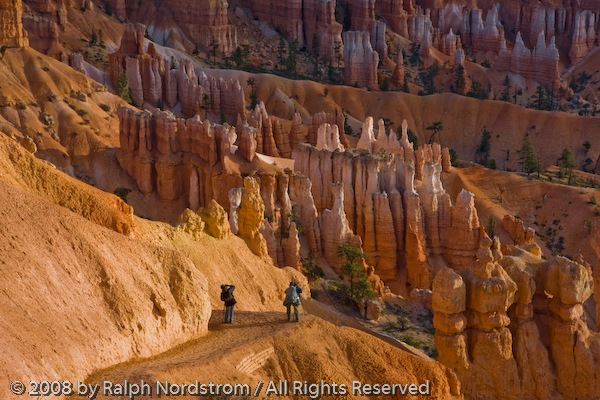
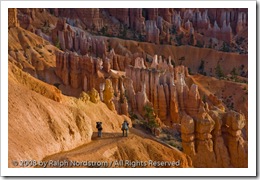
Well, first, you get to photograph an area with someone who is really familiar with it. They know both the great iconic locations plus some out of the way, intimate places.  They are aware of how the light plays on the subjects and can get your to them at the best times of day.  They can respond to developments with the light such as sudden storms and take you to the best locations to take advantage of them.  In other words, they draw upon their intimate knowledge of the area to bring together the two most important factors that go into creating outstanding nature photographs – great subjects and fantastic light.
bryce_workshop

Second, good workshop leaders will freely share their ‘secrets’ with you.  They have acquired a vast amount of knowledge, not only about the area but also about photography in general.  They have their own personal approach to photography.  There can be a lot you can learn from them and they are willing and eager to pass it along to you.

Third, good workshop leaders will spend time working with you one-on-one to help you develop your skills, whether they be creative or technical.  They will spend time working with you in the field on things like exposure, focus and composition.  They will look over your shoulder as you work and offer constructive comments and tips.  They will also take time to review your work and provide you with ongoing feedback. They will also not confine their help to techniques in the field but help you with the critical post processing where the true potential of the photograph is ultimately realized.

The best workshop instructors will also probe you a bit to find out what you want to work on and help you with it.  If you’re not sure, they can help you identify areas of focus.  Their assistance will be very much personalized to your specific needs

How to Select the Workshop for You

There are several things you should think about and look for when selecting a workshop.

Start by thinking what you want to get from the workshop.  Are you primarily interested in a new and exciting location?  Do you want want to grow as a photographer?  Are there specific skills you want to work on?  Is there a photographer whose work you particularly admire?  All of these factors are things you should consider when you start looking for a workshop.

Finding Candidate Workshops

Search engines such as Google and Bing are very effective in helping you find a workshop.  Often people will search for a workshop in a particular location such as “photography workshop, Utah” or “photography workshop, Eastern Sierra.”  This works well if your goal is to photograph in a specific area.  These search sites can produce pages and pages of workshops, especially for the more popular workshop destinations.

Maybe you’re interested in a time of year such as “photography workshop, Napa Valley, fall” or “photography workshop, Death Valley, winter.”  Searches like this can get you to locations when conditions are most favorable and also when you can take enough time off for the workshop.

Finally, you may be interested in the work of a particular photographer.  Searches like “photography workshop, Ralph Nordstrom” or “photography workshop, Jack Graham” will prove effective.

Selecting the Workshop for You

Once you have a list of candidate workshops, how do you go about narrowing it down to just one?

You’ll find lots of information about the workshops on the web.  Based on what it is you determined you most want to get out of the workshop, review the information.  The following are factors you can consider.

Location

This is almost always an primary consideration.  If you’ve searched for workshops by location you should have lots to choose from.  Some websites will post itineraries.  Some will be general while others are very specific.  Take these itineraries with a bit of a grain of salt, especially the very detailed ones.  Rarely does a workshop follow the itinerary.  Conditions will change and the good workshops will adjust to make the most of them.  Itineraries are good, however, to give you an idea of what sites you will be photographing.

Time of Year

This is often another important consideration.  The workshop schedule need to fit with your availability.  But more importantly, they need to be scheduled when the light is the best for the location.  Again, if you searched for this you should have a sufficient number of workshops to choose from.
(c) 2009 by Ralph Nordstrom

Personal Attention

This is where some workshops start to stand out from others.  This is the single most common reason workshop attendees are not totally satisfied with a workshop.  Review the information carefully to see what it says about one-on-one attention.  Read the references from past workshop attendees.  If the workshop leader does not call attention to this either in the information they provide or comments from past participants, chances are you’ll be disappointed in the level of attention you receive.

Reviews

Will the leader review your work?  This should occur early and often.  This way you can incorporate the feedback into subsequent photographs and practice the things they share with you.  Another aspect of this is print reviews.  Does the leader invite you to bring along prints of your work for review and feedback.  Again, review the information carefully looking for some mention of this.  If you don’t see it you may want to strike that workshop from your list.

Assignments

Will you be given assignments during the workshop?  Assignments with the follow-up reviews are terrific learning tools and you could benefit greatly from them.  Again, if this would be of interest to you review the information to determine if assignments will be offered.

Reputation of the Photographer

You may admire the work of a certain photographer and want to study with them.  In that case this could be a primary consideration.  Chances are excellent that they will be going to great locations at the best times of the year.  If the photographer is well known, one thing to keep in mind is their workshops fill quickly (often a year in advance) and they can be pricy – supply and demand you know.  Also, some of the big name photographers will give you lots of personal attention, some will make themselves available for questions but not necessarily reach out to you with suggestions and still others, it’s sad to say, will spend virtually all their time photographing along side you.

Cost

No discussion of workshops would be complete without a word or two about cost.  As mentioned above, the big name photographers will charge commensurate prices.  A few include transportation from the meeting point, lodging and meals but this will usually run several thousands of dollars for a three to five day workshop.  Some of the really high end workshops run as high as $10,000 and more.  Others will charge four figures but leave all the transportation, lodging, meals and fees to you.  You’ll have to evaluate these workshops to determine if you’ll get want you want from them and if it’s worth the price.

There are a lot of lesser known photographers whose workshops are terrific values.  Many of these are very talented photographers in their own right.  Because they’re not as well known their workshops will be more affordable, often half that of what the better known photographers are charging.  And many of them will work very hard to add value that may be missing from the big name photographers.  Generally, this value will be in the form of more personal attention.  When selecting a lesser known photographer’s workshop, be sure to check out his or her work to see if it’s what you like.  It doesn’t make a lot of sense to take a workshop from a photographer whose work you’re not particularly impressed with, no matter how inexpensive it is.

Contact the Photographer

If you think a particular workshop is for you but you still have questions, don’t hesitate to contact the photographer.  Send an email or make a call.  Ask your questions.  Don’t pass up this step.  The photographer will be happy to explore the suitability of his or her workshop with you.

Photography workshops are excellent ways to take your photography to the next step.  But workshops can be costly.  So, when you’re ready to take that step it’s important to make the right decision.  Following the suggestions discussed in this article will help you select the workshop that is right for you.

Join me on an upcoming workshop.

To see more of my photographs click here.

Become a fan on Facebook and follow along.

(1178)

Why I Attend Workshops

Life is too short and there’s too much to learn. I could approach photography on a do-it-yourself basis and grow by trial and error. And while I never stop exploring and discovering new things on my own, it’s slow. Or I can accelerate the learning process and work with other photographers whom I admire. They have a lot to offer and workshops with them gives me the chance to soak up as much as I possibly can in a short, concentrated period of time. And, I get some great photographs.

I’m a professional nature photographer.  I not only take and sell photographs  but also conduct workshops in some beautiful locations around our world.  Admittedly I’m relatively new to the business and am not one of the big names of outdoor photography – yet.  But I have a loyal following that continues to grow.

Like I said, I lead workshops, both on my own and teamed up with other great photographers.  I believe my workshops have a lot to offer photographers of all skill levels from novices and amateurs to professionals.  And our attendees confirm that with their comments.

First of all, we get to great locations and we photograph them in the best light.  Location and light are the two most critical elements for exceptional outdoor photography.

Second, we provide lots of one-on-one attention.  The primary reason most attendees sign up for workshops is they want to become better photographers.  So we really focus on working individually with each photographer on the areas in which they want (and need) to grow.  I say ‘need’ because often the attendees don’t have a clear idea of what areas to focus on and we can help with that.

Third, my partners and I have our own unique personal styles of photography that we share with our attendees, both overtly and in more subtle ways.  If an attendee knows our work, presumably they like it and may want to learn how to do what we do for themselves.

So, with all that by way of introduction, that’s why I attend workshops.  I can photograph unfamiliar areas of our earth with someone who is intimate with the location, its best views and light.  Second, I may feel pretty comfortable with my technical and creative skills but, let’s face it, there’s always more to learn.  Happily, it’s a never ending process.  Thirdly, the workshop instructor’s personal style is just that – personal, unique to that individual.  Working with them for three to five days is a wonderful way to absorb some of their magic and stretch my own personal style.  After all, simply put, our personal styles are our means by which we express yourselves through our art.  It is something that is growing all the time.  Working with other skilled photographers just helps it grow faster.

To sum it all up, life is too short and there’s too much to learn.  I could approach photography on a do-it-yourself basis and grow by trial and error.  And while I never stop exploring and discovering new things on my own, it’s slow.  Or I can accelerate the learning process and work with other photographers whom I admire.  They have a lot to offer and workshops with them gives me the chance to soak up as much as I possibly can in a short, concentrated period of time.  And, I get some great photographs.

Join me on an upcoming workshop.

To see more of my photographs click here.

Become a fan on Facebook and follow along.

(986)

Epson 4800 Tip

A tip for preventing nozzles from clogging.

I have an Epson Stylus Pro 4800 printer that I basically love.  Having a high quality printer like the Epson really unleashed my creative potential by giving me the ability to fine tune my photographs.  Sending proofs off to labs and even waiting only a couple of days to get them back (like some of the better labs do) just wasn’t working out.  Realistically, I could only do a couple of proofs.  But with my own printer I can run scores of proofs if I need to.

There is one thing about the Epson that’s been bugging me though.  I have nozzle clogging problems.  It’s from two things – the relatively dry atmosphere here in Southern California and the fact that I don’t print every day.  It gets so bad that I would sometimes have to spend an hour repeating the nozzle check and head clean before I could start printing.  It wasn’t fun.

But last weekend I heard a tip from two people.  Musical instruments, especially the kind made from wood, suffer from the wood drying out in low humidity conditions.  And that affects the quality of the sound.  So musicians purchase a humidifier device to put in their instrument cases.  It maintains the humidity inside the case at an optimum level which keeps their instrument sounding its best.

The suggestion was to purchase one of these and place it inside the 4800.  Well, the advice made total sense but I took a different tack.  We had a Starbuck’s shot glass sitting around.  I took a kitchen sponge and cut it into four strips.  Two of these fit perfectly in the shot glass.  Moisten the sponges, insert them in the glass, add a little extra water (not too much), set it inside the printer way out of the way where the print head wont hit it, and cross fingers.  After one day I  ran a nozzle check.  Wow, it was almost perfect, good enough to try a print.  I printed a proof and it was just great.

Since then I’ve printed more and it’s working perfectly.  I check the water level every other day or so and am amazed at how quickly it goes down.

So, while time will tell, it seems the nozzle clogging problem may be solved.  And I don’t have go to through the onerous chore of unclogging nozzles before I can print.  I’m cranking out proofs and feeling productive and creative again.  I’m a happy camper.

Join me on an upcoming workshop.

To see more of my photographs click here.

Become a fan on Facebook and follow along.

(1165)

The Making of a Photograph Part 3 – Photoshop First Round

In part one and two of this series I described how I selected the file to work on and explored the potential of the image in Lightroom.  The treatment I ended up with would be exported into Photoshop and we go from there.

Read Part 1

Read Part 2

After trying several approaches particularly with regard to the color of the light I selected one that was very much like the unadjusted file.  The only change was opening up the shadows in the valley floor a bit.

Yosemite_4Now the fun begins.  While Lightroom 2.x supports local adjustments I prefer to do the local adjustments in Photoshop.  I just feel that I have more control in Photoshop.

The first thing to deal with is the silhouette of the pint tree in the lower left hand corner.  I used the clone stamp tool to get rid of that.  I have no qualms about removing things that distract from the image.  But I draw the line at adding things.  Someone asked me if I added the moon in Bristlecone Moonrise.  No, I was there and that was the moon.  What’s the point of faking it.  The experience in the field would simply not be the same.  It’s so exciting to take an image like this and think you’ve got it.  But there’s always the nagging doubt in the back of your head wondering if you overlooked something and messed it up.   You never know until you get back at your computer to see what you really have.

bristlecone_moon_2008

But back to Yosemite.  So the pine tree silhouette had to go.  Also, I checked the image for dust spots and only found one or two.  The spot healing brush took care of them.

The next step was to do some local adjustments with Viveza.  It’s a cool tool from Nik Software that allows you to select an area and control brightness, contrast, saturation and more.  The clouds in the upper right needed contrast enhanced a little.  Next a couple of Curves with layer masks helped open up the valley floor even more.  I tried some vignetting on the bottom and really liked the way it funneled the eye into the center of the image where everything was happening.  I didn’t think I’d need any  vignetting for the top corners but tried it anyway and liked that too.

I made some global adjustments too.  Selective Color helped warm the reds with some yellow, lighten the yellows and darken the blues.  Color Balance also shifted the overall color just a couple points to the yellow.

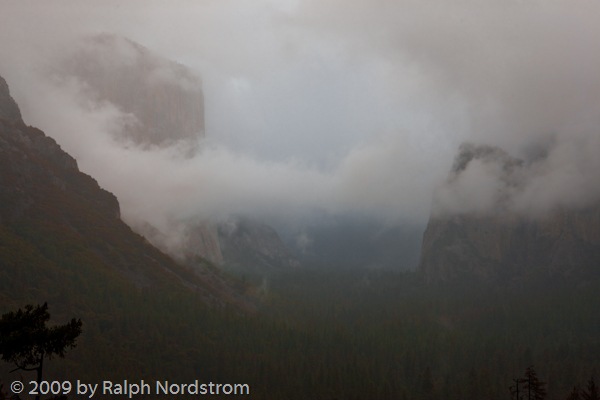
Sorry I don’t have images of each of the steps along the way but that pretty much finished up the first evening.  The image was starting to get interesting and it was time to sleep on it and come back another day to take a fresh look at it.

Yosemite_1
Original Capture
Yosemite_Edit_1
After Photoshop Session 1

Here are the two side-by-side.  It’s starting to take shape.  There’s a little hint of warmth in the clouds and they stand out more from the background.  The valley floor is better defined and the trees stand out a bit more.  There’s actually a subtle feeling of warm light down there.  El Cap and Bridle Vail Falls also are more prominent and their warmer tones contrast more with the overall picture’s coolness.  You can click on the images to enlarge them.

Even before I fell asleep that night I was thinking of what needed to be done next.  As you work on an image you become satiated to the colors, tonalities and contrast and you can’t tell if they are good or not.  You also get emotionally involved.  So it’s good to stop, get away from it and return another day.  Sometimes when you return you are pleased and other times you say to yourself, “What was I thinking?”  When I get the latter reaction it usually means starting over from the beginning.  We’ll come back to this technique when you get far enough along to start making proofs.

So come back for #4 in this series to see if I  said, “What was I thinking?” or if I picked up from where I left off.

To see more of my photographs click here.

Join me on an upcoming workshop.

Become a fan on Facebook and follow along.

(1045)

On the Virgin River Bridge at Sunset

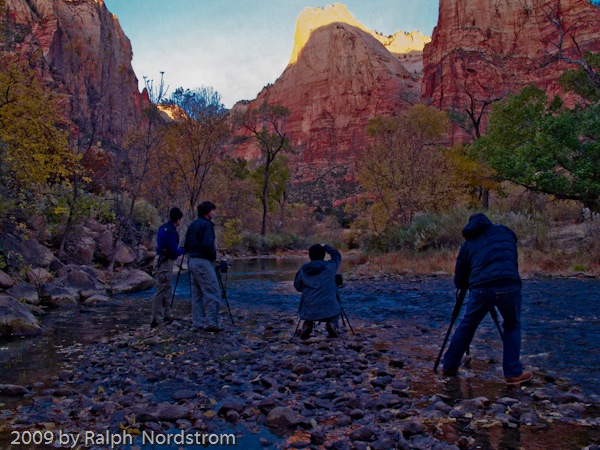
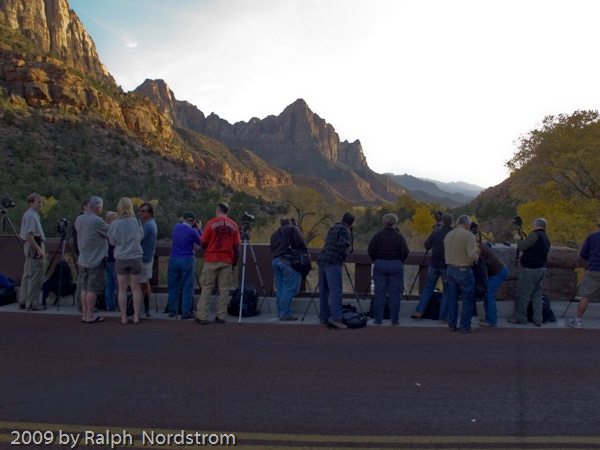
Zion National Park in Southwest Utah has a sundown tradition amongst photographers of all kinds.  We gather on the bridge over the Virgin River in hopes of being there for one of those spectacular sunsets that can only be viewed here.

It doesn’t always happen.  But the ritual continues.  About two hours before sunset we start assembling.  Talk to your fellow photographers and you’ll likely find people from around the world.  Or, someone from your own back yard.

Soon the crowd builds and begins to spread out across the bridge, jockeying for the best locations.  So we tend to bunch up around the premium spots.

(c) 2009 by Ralph Nordstrom

Continue reading “On the Virgin River Bridge at Sunset”

(610)