A continueing series in which I reflect on Ansel Adams’ book, “Examples – The Making of 40 Photographs.” In this post I talk about “El Capitan, Winter Sunrise.”
I’ve heard it said that many photographers believe there are no more photographs in Yosemite, that all the great ones have been taken. And it’s true that the prime locations have been photographed again and again, sometimes with 50 or even 100 photographers all vying for their three square feet of ground in which to set up their tripods.
It would appear the assumption is that if a particular location is photographed too many times, becomes too popular, it becomes a cliché. I’ve succumbed to that point of view in the past. There seems to be the faintest whiff of, “I’m too good to photograph something so common. I’m able to find what no one else has never seen.” I know; I kind of felt that way.
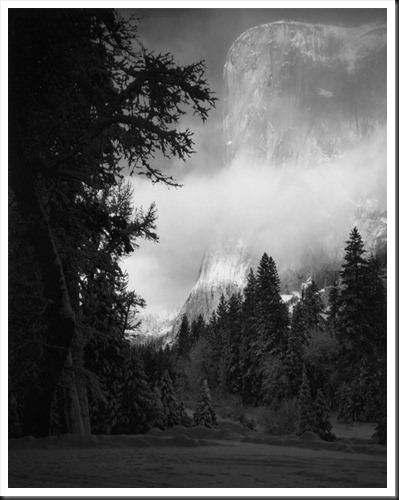
El Capitan, Winter Sunrise
Ansel Adams
Ansel Adams had something to say about that in connection with this photograph.
“A viewer once asked me about the values: ‘Don’t you think the trees are rather dark?’ Black and white photography gives us opportunity for value interpretation and control. In this instance, were the trees lighter in value, the glow of the light on the cliff would, for me, be far less expressive. Exposing for higher forest values would have weakened the separation of the far brighter cliff and cloud values. However, other photographers might well make quite different images. I would not like anyone to think I believe this image to be the only one possible, but it fulfills my visualization at the time of exposure. In an overpowering area such as Yosemite Valley it is difficult for anyone not to make photographs that appear derivative of past work. The subjects are definite and recognizable, and the viewpoints are limited. It is therefore all the more imperative to strive for individual and strong visualization.”
Adams’ comment gets to the heart, mind and soul of the artist. There are two key concepts in his statement that, for me, define art. The first is ‘interpretation. ’Black and white photography gives us opportunity for value Interpretation and control.” I take from this that our photographs are interpretations of the subject. After all, art is interpretation. And, as artists, it is through interpretation that we share with our viewers our vision of the world. We don’t document reality; we interpret or possibly even create reality.
The other concept that catches my attention is ‘individual … visualization.’ Adams speaks of his ‘visualization’ all the time. And the reason we enjoy his photographs so much is because of his strong visualizations. When he tripped the shutter he knew what effect he wanted to create with the image. He knew what he wanted to convey in terms of what he was feeling and he knew how to do it, especially when he developed and refined the Zone System.
And it was his interpretations and visualizations that took a location that had been photographed time after time by many other photographers and turned it into something uniquely and identifiably his.
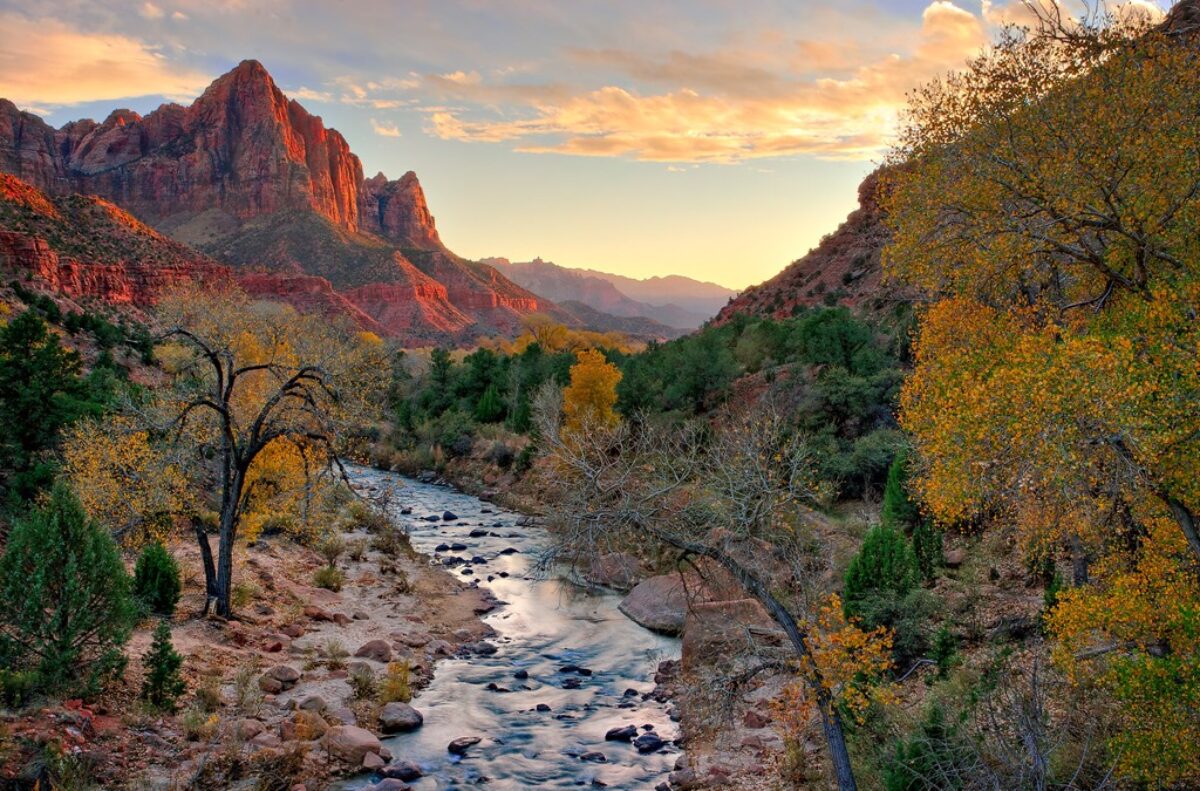
So stand on the bridge in Zion or line up to photograph Delicate Arch in Arches or join the throng at tunnel view in Yosemite. You can make your photograph unique through your own strong vision and interpretation.
This is a continuing series based on my reading of Ansel Adams’ wonderful book, “Examples – The Making of 40 Photographs.” It is exciting to read of his attitudes towards making photographs, the decisions he made and the techniques he employed and apply them to the issues that confront us today as digital landscape photographers. I think those of us who ‘Photoshop’ our images for the sake of achieving our visualization can feel a comradeship with the master. The question, “Did you manipulate that photograph?” will never go away as long as our medium is the camera. Adams was also confronted with the same question. For those of use that believe that the purpose of making a landscape photograph is to share with our audience our response to and our connection with the subject, the work is not done when we press the shutter, it’s just beginning. And we can delight in photographing the cliché locations, time and time again, because we are creating our own individual statement, not creating ‘derivatives’ of others’ works.
If you enjoy these posts please feel free to share them on Facebook or Twitter, or email them to your friends. And we would really enjoy hearing from you. Join the conversation – leave a comment.
Join me on an upcoming workshop. Click here for more details.
To see more of my photographs click here.
WordPress Tags: Ansel,Adams,Capitan,Winter,Sunrise,Yosemite,assumption,location,times,cliché,whiff,connection,viewer,trees,Black,photography,interpretation,instance,cliff,separation,images,image,visualization,exposure,area,Valley,heart,soul,artist,statement,subject,viewers,vision,world,concept,attention,System,bridge,Zion,Delicate,Arch,series,Photoshop,comradeship,purpose,audience,response,locations,feet,tripods,subjects,viewpoints,concepts,interpretations,artists,Examples,attitudes,decisions,techniques,photographers,visualizations
(3269)
Like this:
Like Loading...