In the first post (http://ralphnordstromphotography.com/wordpress/2008/02/18/journey-to-a-fine-art-photograph/) I talked about the importance of the first step you take with your image, the opening move if you will. I don’t know if this ever happens to you but it happens to me all the time – I work on an image for several evenings only to end up in a box canyon, a dead end. It’s not going anywhere. And so very often I think, “Wow, I started it all wrong. I did X but if I had done Y I would have avoided this problem.” It’s too bad but sometimes the weaker opening move isn’t manifested until you have quite a few hours invested in the image. But the only thing to do, if you still believe in the image, is to start all over again. Maybe you do so right away or maybe you set it aside for some weeks or months and just let it ferment in your mind.
That leads to another ‘Ah Ha’. Do you ever sit staring at an image and ask yourself, “What do I do next?” Like I said before, I’m of the school that discovers the emotional content of an image as I work with it, not necessarily in the field when I’m shooting it. “Discover” is the key word here. Here’s the way it seems to me – it feels like walking across a meadow in a thick fog. Sure, you can see one or two steps ahead but you can’t see the other side of the meadow until you get really close.
Each step you take is based on the one or two most obvious things you see when you look at the image. Perhaps the first thing you notice is the need to address contrast. You choose a tool to deal with it, say curves. Once that’s corrected you see another thing, say color. Maybe you choose selective color for that. Next you see something else, perhaps a highlight that’s distracting from the overall composition. You choose a tool to correct that, say dodge and burn. And on you go, step by step, dealing each time with the most obvious correction that is calling out to you.
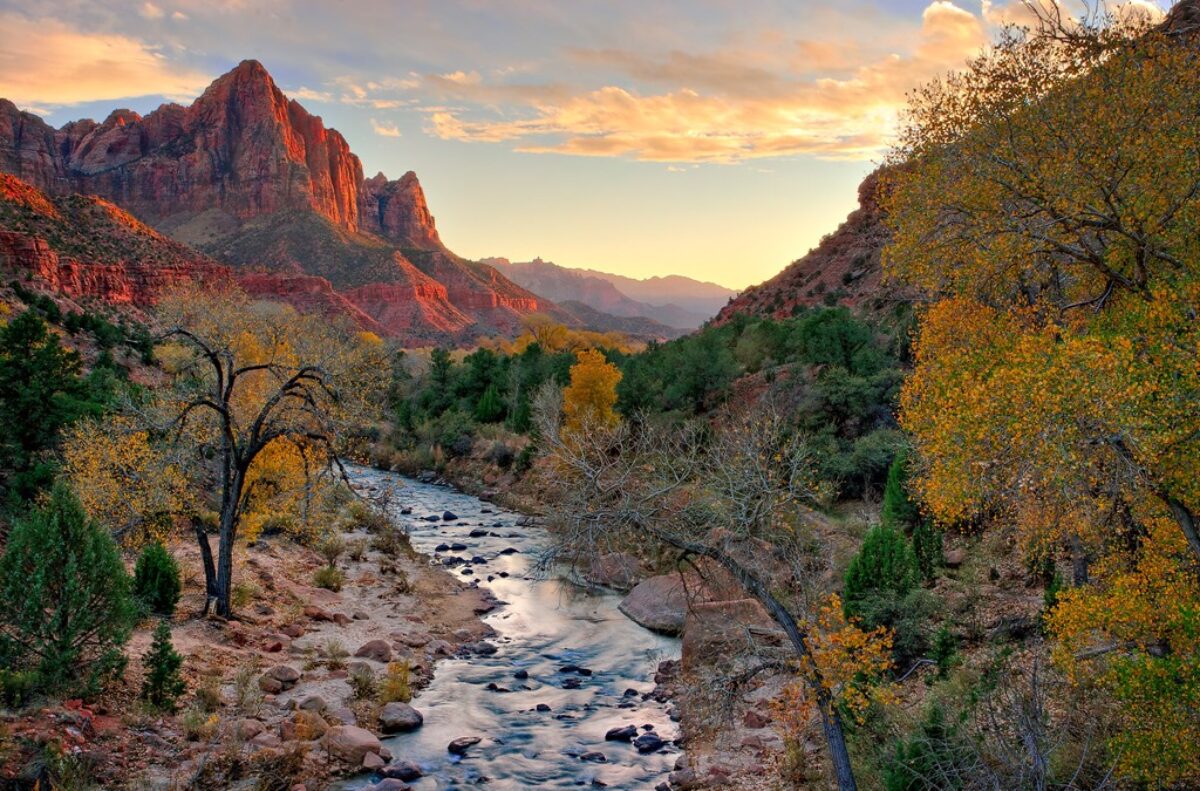
It’s in this process of picking our way across the creative meadow, through the fog, step by step that our personal style emerges. Because, two artists looking at the same image on identical monitors will respond differently. They may very well see different things calling out for attention. And even if they see the same thing, the tools they choose to address them may be different. And even if the tools are the same, the way in which they apply the tools will most surely be different. And that’s just one step in the journey. There are many, many more to go. It’s fun listening to people who criticize us when we stand shoulder to shoulder with other photographers, cameras all pointed in the same direction, clicking away like mad. They laugh about the individuality of artistic expression. But of the two dozen or so photographers I shared the bridge with over the Virgin River shooting the Watchman in Zion this past Thanksgiving, I’ll lay odds that not a one of them has a photograph that looks anything like mine. Not a one of them took the same path across the foggy meadow that I did.
The foggy meadow analogy also works to understand the importance of the first step you take with the image. If it’s to the left, the right or straight ahead, you’ll end up in a different place on the other side. You may end up in a place that you find inspiring or you may not.
The journey across the meadow can also be a journey of self discovery. As you progress, the image takes on more meaning. And as it does, you perhaps relate to the emerging meaning in ways that are new for you, ways that give you an insight into yourself, a deeper understanding of your inner self. This in turn can lead toward exploring the image in yet different ways which can reveal new layers of meaning. In this way, you and the image leap frog across the foggy meadow in a journey of understanding and self-actualization.
So, that a marvelous, miraculous and mysterious journey this is, from the field to the digital darkroom to eventually an expressive image hanging on the wall that carries so much of you, just as you carry the image and the journey that led you to it.
(408)
Like this:
Like Loading...