The single lens reflex camera (SLR), whether film or digital, allows the photographer to change lenses. And the selection of one lens or another can have a powerful impact on the message of a photograph. It’s more than wide angles giving you the grand picture and telephotos getting you up close and personal. There are other effects that lenses have on the final photograph.
(Here’s a short excerpt of a talk I gave last Saturday night (6/6/09) at the reception for my one-man-show in South Pasadena, California.)
When I do art festivals and street fairs, many people enter my booth and ask me if I’m the photographer. I answer, “Yes I am.” Very rarely does someone ask me if I’m the artist.
It seems there is not a strong connection in many peoples’ minds between photography and art. That is further evidenced by another question I get a lot – “Do you manipulate that photographs?” My answer to that is, “Of course.” That’s the short answer. The longer answer is, “I approach photography from the mind set of a painter. I reserve for myself all the creative and artistic freedom a painter has.” To this they usually respond, “Oh, I get it. You’re an artist.”
The second entry into the Orange County Fair this year is one that I planned for well over a year – Bristlecone Moon. The bristlecone pine are the oldest living trees on the planet. The oldest of these is over 4,800 years old. Imagine, not only will it outlive you and I, not only has it outlived our ancestors, but it has outlived whole civilizations.
When I first got my Epson 4800 printer I was tackling so many learning curves all at once that I really didn’t spend any time experimenting with papers. I was learning the virtually unlimited possibilities with Photoshop, getting used to the vast field of color management, Lightroom came along and that presented a new learning curve, HDR with PhotoMatix, LightZone, Photokit Sharpener, Imaginomics Noiseware Pro and more. Plus I was focusing on composition, light, post processing, soft proofing, etc.
It’s no wonder that paper was not high on my list of things that needed my complete focus and attention. I settled on Epson Enhanced Matte, a paper that gave me the effect I was looking for; that is, photographs that looked like paintings. And given the number of artist’s proofs I had to print before I got a print that I was satisfied with, it didn’t hurt that it was a fairly inexpensive paper.
Epson Enhanced Matte is a really nice paper for what I wanted to do. And I’ve never looked back at the decision to go with matte. I briefly tried some glossy and luster papers and didn’t like what they did for my photographs. So I was happy to stay with a matte surface.
But I didn’t realize when I started that the low D Max would be a challenge or that there would also be some color gamut difficulties, especially in the yellow-browns. These made working with some images rather formidable. It took a while but I finally started understanding what was going on and anticipating and pretty much avoiding these problems. Then… Continue reading “Red River Paper”
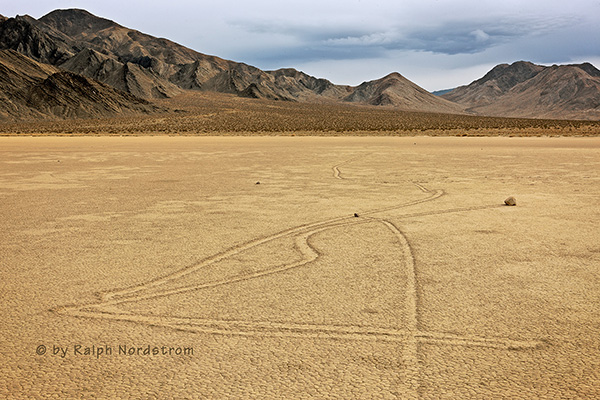
I was fortunate to visit the Racetrack Playa in Death Valley November of last year. This is where rocks mysteriously slide around, leaving tracks in their wake. Many slide for hundreds of feet and more. Some move with seeming purpose in pretty much a straight line while others meander about, changing directions on a seeming whim.
The journies of these rocks are illustrated by the following photographs.
The Wanderer, Racetrack Playa, Death Valley, CA
Or consider the meanderings of these two rocks.
Traffic Jam, Racetrack Playa, Death Valley, CA
If you trace back the path of the rock on the right you will be amazed.
It’s a joy to wander over the playa for literally miles in search of these often whimsical rocks. However, when I was last out there I saw some very disturbing signs of greed and total disregard for others and the wonders of our earth. Scores of tracks had no rocks – at either end. People were carting them off. You might not be surprised to see one or two tracks without the rocks that made them. But to see scores was both upsetting and heart breaking. And to top it off, there were car tracks on the playa. Some idiots drove their vehicle out there for, what could only be to make off with even more rocks.
It’s callous ignorance like this that makes one feel the need even more urgently to redouble our efforts to preserve treasures like these. I’ve said in this blog before that it just takes one. You only cut a virgin forest once, build a highway through a pristine wilderness area once, wipe out a species once, remove racetrack rocks once and they are gone forever.
If you sell fine art photography you hear this a lot, “I don’t need to buy your photographs. I’ll go there myself and take my own pictures.”
Sure, why not? We all have digital cameras these days that do a great job of producing really fine pictures – some of the time. I would never argue with a person with this attitude but even if you’re a great photographer there are good reasons for purchasing other photographer’s works.
I don’t think anyone would argue that it would be a wonder to own an Edward Weston original platinum print. But let’s look at some factors that are more down to earth.
Let’s start with capturing the best light. A landscape photograph is nothing without great light. Usually that’s early in the morning or late in the afternoon although good light can occur any time of day. Is our intrepid photographer going to be on site a half hour or more before sunrise? I know from lots of personal experience that you pretty much have a location to yourself before sunrise. It’s funny to see people just starting to show up, cameras and tripods in hand, after we’ve shot through the best light and now that it’s gone we’re ready for breakfast.
How about subject selection and composition? We all have our own personal ways of seeing and interacting with the world around us. How we choose to select a subject, isolate it and place it along with other components into a composition is a very individual process. The end result says as much about the photographer as it does about the subject, maybe more. So each work is a unique expression of an individual with his or her own very personal viewpoint. You see this very clearly at workshops when the participants gather around to share their work. The diversity is enlightening.
Then we come to post processing. This is where the photographer’s personality comes forth even more strongly and loudly. There are many decisions that come between uploading the RAW file and producing the final print. I’m plagued with false starts in which I have to go back to the RAW file and begin again from square one. There is a large variation in the techniques different photographers will apply in post processing and hence a large variation in the results.
So, why would a photographer want to by other photographers’ works? Because there is so much to learn from the photographers you admire and one good way to learn it is to have their works around you every day.
I print my fine art prints with Image Print, an excellent RIP. And I print on an Epson 4800. Image Print gives you the option of printing at 180 or 360 ppi. I’ve printed a lot of great looking, rather large photographs at 180 ppi. A lot of my friends are shocked. They say I’m compromising the quality of the print. But no matter how close I scrutinize the prints I really can’t see any difference.
Enter Genuine Fractals. Genuine Fractals really objects if you try to resize an image to 180 ppi. The smallest it is comfortable going is 240. To get it to accept 180 ppi I have to fake it out.
But the fact that it defaults ot 240 raises all sorts of questions. What if I resize at 240 ppi and print at 180 or 360? For that matter, is there a difference between 180 and 360. So the other day I was printing some 16X24 images and decided it was time to finally ran a test.
I have a couple of Lee graduated neutral density filters in my camera bag. I don’t use them very much because I’m kind of an HDR guy. But the past couple of mornings we’ve had some very clear sunrises and given the location of our home in the Southern California foothills this turned out to be a good opportunity to play around with my grad ND filters.
I discovered a few very interesting things. I’m just going to provide a checklist here without any illustrations. Hopefully it will make sense.
I have a good friend who is a very fine photographer who hates Photoshop. Not me. I love it and will spend days and weeks on a single image. But my friend hates Photoshop and wants to get done with it as quickly as possible.
So I showed him a simple two-step approach to Photoshop that gets you a long ways toward a great looking photograph. And I’d like to share it with you now.
There’s a lot of talk amongst photographers about shooting in the golden hours – around sunrise and sunset. There’s no disagreement that the light is wonderful at those times of the day. The low angle gives excitingly long shadows and the fact that the sunlight has to travel through more of our atmosphere means it’s a bit softer and a lot warmer.
So you often find a lot of photographers lining up for sunset shoots at iconic locations. The bridge over the Virgin River in Zion is a perfect example. I’ve got to admit, I love to shoot sunsets from the bridge myself. Most photographers will arrive early and stay about 20 minutes after the sun disappears below the horizon at which time the pack up and head off to dinner.
I like to stay till I can’t shoot any more. The light show isn’t over by any means when the glow on the clouds fades. It’s just a lot more subtle. As the light fades exposure times increase and when you get up to 30 seconds then ISO starts to bump up.
Why do I like this light so much? Well, because there is so much going on. Many complex and intricate things are going on in the sky above. You end up getting a delicate play of warm and cool light. Everything is enveloped in a quiet, soft luminance. It can be a magic unlike any other time of day.
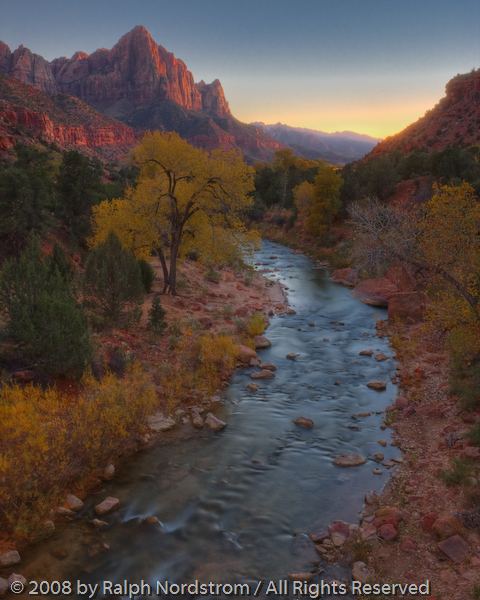
I was shooting on that famous bridge in Zion back in November. If it hadn’t been for my two friends shooting with me I would have been the only one on the bridge. Everyone else had long gone. I was shooting HDR, 5 bracketed shots, something I’ve found to be very effective (don’t forget, the sky stays bright long after the sun disappears). Each shot was varied by 1 1/3 stop. Post processing consisted of Photomatix and a little Light Room. Here’s what I got. (You can click on these images to enlarge them.)
Watchman at Twilight
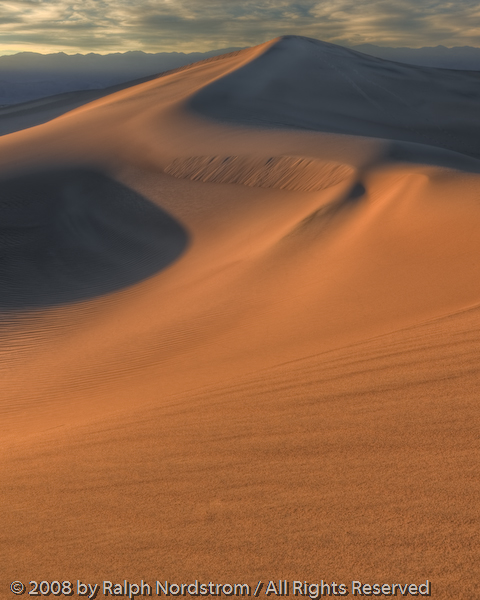
A few weeks before I took this Zion twilight shot I found myself in Death Valley on the Mesquite Flats Dunes, again at sunset. I set up on this one composition and shot it for about an hour and a half. Many people like the stark contrast created by the sun playing on the undulating surfaces of the dunes. I like it too.
Mesquite Dunes Sunset
But a while later comes the real show, at least for my money. The play of colors becomes outrageous with reds, magentas, purples, oranges, yellows and blues. And I love the forms and textures of the sand. It’s truly amazing.
Mesquite Dunes Twilight
So for my money, you’ll see me out there (usually by myself) until I can’t shoot any more. Hey, why don’t you join me and see for yourself.
Then and only then I’ll pack up my gear and head off for dinner.
Note: All of the above photographs are HDR, not just Zion.