I was fortunate enough to have all three photographs accepted for the Orange County Fair this year. And I was very surprised to learn that all three had won awards. To today I finally made it out to the fair and sure enough they all had ribbons.
I have a couple of Lee graduated neutral density filters in my camera bag. I don’t use them very much because I’m kind of an HDR guy. But the past couple of mornings we’ve had some very clear sunrises and given the location of our home in the Southern California foothills this turned out to be a good opportunity to play around with my grad ND filters.
I discovered a few very interesting things. I’m just going to provide a checklist here without any illustrations. Hopefully it will make sense.
I have a good friend who is a very fine photographer who hates Photoshop. Not me. I love it and will spend days and weeks on a single image. But my friend hates Photoshop and wants to get done with it as quickly as possible.
So I showed him a simple two-step approach to Photoshop that gets you a long ways toward a great looking photograph. And I’d like to share it with you now.
There’s a lot of talk amongst photographers about shooting in the golden hours – around sunrise and sunset. There’s no disagreement that the light is wonderful at those times of the day. The low angle gives excitingly long shadows and the fact that the sunlight has to travel through more of our atmosphere means it’s a bit softer and a lot warmer.
So you often find a lot of photographers lining up for sunset shoots at iconic locations. The bridge over the Virgin River in Zion is a perfect example. I’ve got to admit, I love to shoot sunsets from the bridge myself. Most photographers will arrive early and stay about 20 minutes after the sun disappears below the horizon at which time the pack up and head off to dinner.
I like to stay till I can’t shoot any more. The light show isn’t over by any means when the glow on the clouds fades. It’s just a lot more subtle. As the light fades exposure times increase and when you get up to 30 seconds then ISO starts to bump up.
Why do I like this light so much? Well, because there is so much going on. Many complex and intricate things are going on in the sky above. You end up getting a delicate play of warm and cool light. Everything is enveloped in a quiet, soft luminance. It can be a magic unlike any other time of day.
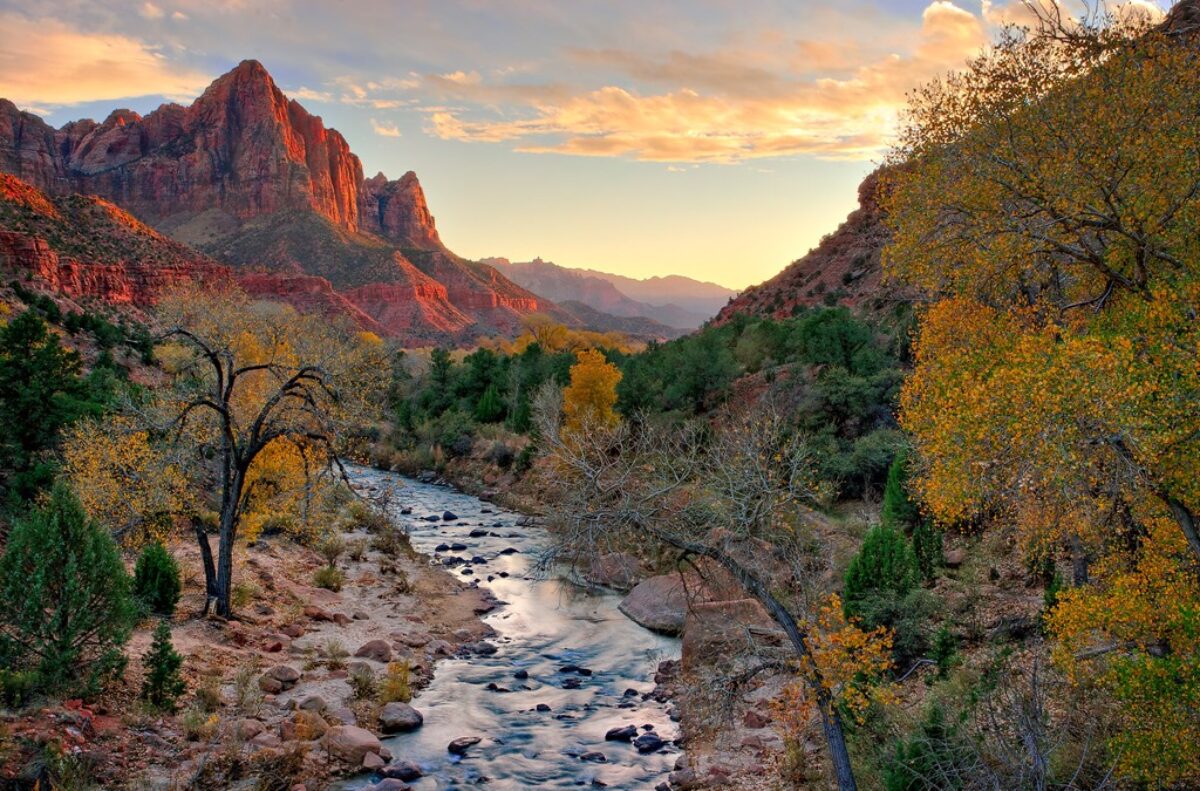
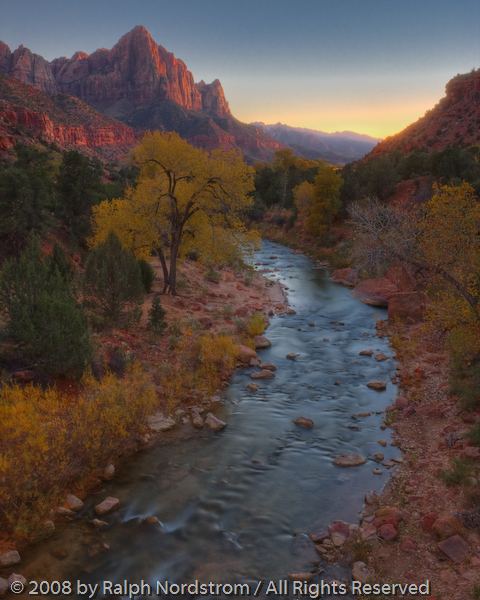
I was shooting on that famous bridge in Zion back in November. If it hadn’t been for my two friends shooting with me I would have been the only one on the bridge. Everyone else had long gone. I was shooting HDR, 5 bracketed shots, something I’ve found to be very effective (don’t forget, the sky stays bright long after the sun disappears). Each shot was varied by 1 1/3 stop. Post processing consisted of Photomatix and a little Light Room. Here’s what I got. (You can click on these images to enlarge them.)
Watchman at Twilight
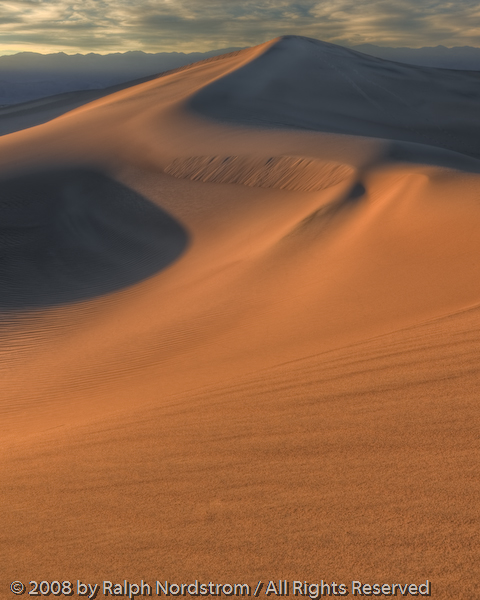
A few weeks before I took this Zion twilight shot I found myself in Death Valley on the Mesquite Flats Dunes, again at sunset. I set up on this one composition and shot it for about an hour and a half. Many people like the stark contrast created by the sun playing on the undulating surfaces of the dunes. I like it too.
Mesquite Dunes Sunset
But a while later comes the real show, at least for my money. The play of colors becomes outrageous with reds, magentas, purples, oranges, yellows and blues. And I love the forms and textures of the sand. It’s truly amazing.
Mesquite Dunes Twilight
So for my money, you’ll see me out there (usually by myself) until I can’t shoot any more. Hey, why don’t you join me and see for yourself.
Then and only then I’ll pack up my gear and head off for dinner.
Note: All of the above photographs are HDR, not just Zion.
I just ran another test on Genuine Fractals. Here it is.
I’m working on an image for the Orange County Fair and I want to blow it up to 16X24. It is Kolob Terrace taken with my 10D last year in Zion so the image size is 3072X2048 or 6 M pixels.
I use Image Print to make my prints on my Epson Stylus Pro 4800. Image Print likes to print at two PPI settings – 180 and 360. So here is the question: Can I get the same degree of sharpness with Genuine Fractals at 360 PPI as I can get with 180 PPI?
Improve your photography skills, stimulate your creativity and have a fantastic time.
I picked up Genuine Fractals by onOne software this weekend. What does it do? It allows you to upscale your digital images. And just what is upscaling? It comes down to adding pixels to your image to make it larger. Whenever you add pixels you have a problem. What color and intensity should the new pixels be?