I’m always buying photography books and on the lookout for good DVDs. I like the books because I can read them at my leisure. And if they contain assignments at the end of each chapter that’s even better. DVDs, on the other hand, can be even better because you can see the photographer in action.
But not all DVDs live up to this level of expectation. Sure, you can get see where the photographers are photographing. And often you can see what they captured. But all too often you aren’t privy to what is going through their minds. Well, I found a DVD that sets the standard.
I have a couple of Lee graduated neutral density filters in my camera bag. I don’t use them very much because I’m kind of an HDR guy. But the past couple of mornings we’ve had some very clear sunrises and given the location of our home in the Southern California foothills this turned out to be a good opportunity to play around with my grad ND filters.
I discovered a few very interesting things. I’m just going to provide a checklist here without any illustrations. Hopefully it will make sense.
I have a good friend who is a very fine photographer who hates Photoshop. Not me. I love it and will spend days and weeks on a single image. But my friend hates Photoshop and wants to get done with it as quickly as possible.
So I showed him a simple two-step approach to Photoshop that gets you a long ways toward a great looking photograph. And I’d like to share it with you now.
There’s a lot of talk amongst photographers about shooting in the golden hours – around sunrise and sunset. There’s no disagreement that the light is wonderful at those times of the day. The low angle gives excitingly long shadows and the fact that the sunlight has to travel through more of our atmosphere means it’s a bit softer and a lot warmer.
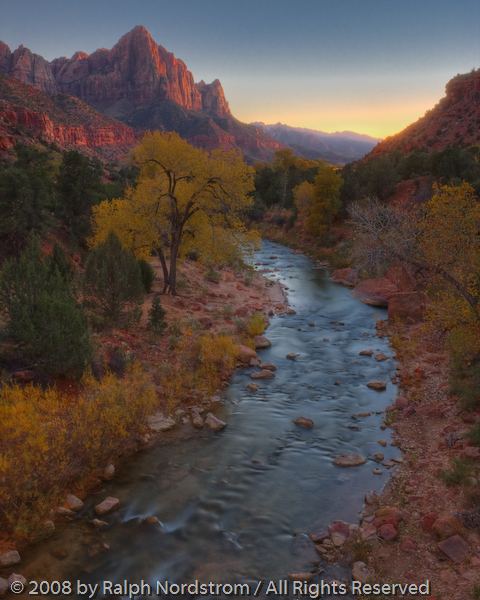
So you often find a lot of photographers lining up for sunset shoots at iconic locations. The bridge over the Virgin River in Zion is a perfect example. I’ve got to admit, I love to shoot sunsets from the bridge myself. Most photographers will arrive early and stay about 20 minutes after the sun disappears below the horizon at which time the pack up and head off to dinner.
I like to stay till I can’t shoot any more. The light show isn’t over by any means when the glow on the clouds fades. It’s just a lot more subtle. As the light fades exposure times increase and when you get up to 30 seconds then ISO starts to bump up.
Why do I like this light so much? Well, because there is so much going on. Many complex and intricate things are going on in the sky above. You end up getting a delicate play of warm and cool light. Everything is enveloped in a quiet, soft luminance. It can be a magic unlike any other time of day.
I was shooting on that famous bridge in Zion back in November. If it hadn’t been for my two friends shooting with me I would have been the only one on the bridge. Everyone else had long gone. I was shooting HDR, 5 bracketed shots, something I’ve found to be very effective (don’t forget, the sky stays bright long after the sun disappears). Each shot was varied by 1 1/3 stop. Post processing consisted of Photomatix and a little Light Room. Here’s what I got. (You can click on these images to enlarge them.)
Watchman at Twilight
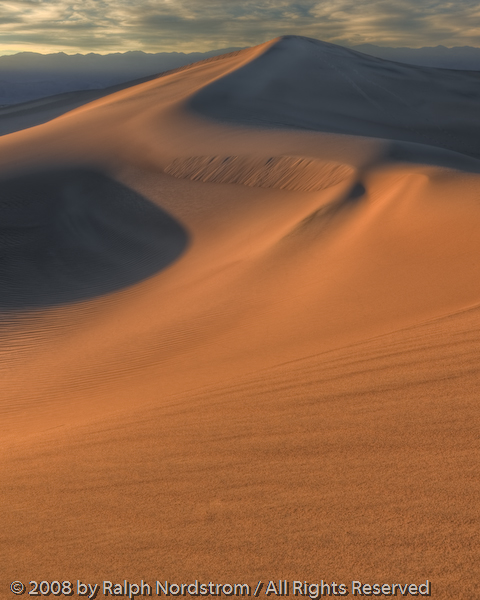
A few weeks before I took this Zion twilight shot I found myself in Death Valley on the Mesquite Flats Dunes, again at sunset. I set up on this one composition and shot it for about an hour and a half. Many people like the stark contrast created by the sun playing on the undulating surfaces of the dunes. I like it too.
Mesquite Dunes Sunset
But a while later comes the real show, at least for my money. The play of colors becomes outrageous with reds, magentas, purples, oranges, yellows and blues. And I love the forms and textures of the sand. It’s truly amazing.
Mesquite Dunes Twilight
So for my money, you’ll see me out there (usually by myself) until I can’t shoot any more. Hey, why don’t you join me and see for yourself.
Then and only then I’ll pack up my gear and head off for dinner.
Note: All of the above photographs are HDR, not just Zion.
High Dynamic Range or HDR has become a standard and often used tool when I’m in the field. For example, a few weeks ago when I was shooting sunrises in Bryce Canyon we would arrive well before sunrise. Generally I would start shooting when it was light enough to get a good exposure at 30 second, ISO 100 and f/16. That’s a good 20 to 30 minutes before the sun peeks over the horizon. In that wonderful pre-sunrise light the dynamic range is very low, maybe a total of four or five stops. There is no need for HDR because under those circumstances I can get a good 8 and if I want 9 stops of dynamic range from my sensor.
But as soon as the sun is above the horizon all that changes. The dynamic range jumps to at least 8 stops, probably more. (I don’t take the time to scintifically measure the dynamic range because things happen so fast in those first few minutes.) I don’t want to take any chances with that incredible light so I switch to HDR, just for insurance if nothing else.
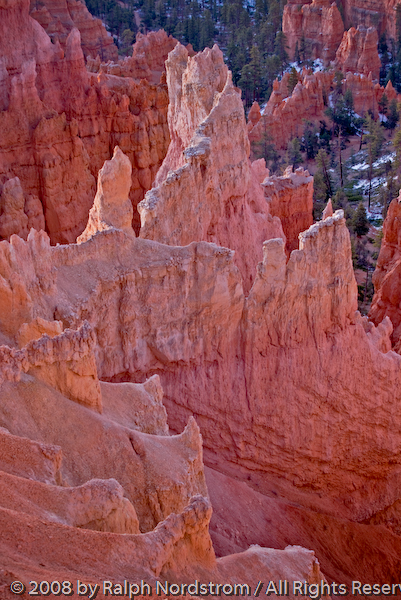
The trip to Southern Utah is starting to yield some results. And while this is still preliminary (that is to say, it hasn’t been proofed yet), this one is a favorite. And, it was just about the first shot I took.
Sunrise at Sunrise Point
There are no comments to add at this point, just the soft glow of a beautiful morning.
Like many photographers, I use a remote release when shooting landscape photography. Why? So that I don’t jiggle the camera when I push the shutter button. (The camera is on a sturdy tripod of course.) However, I found a better way to keep the camera steady.
It was a week ago today that I arrived home from a week of shooting in Southern Utah. As wonderful as California is with its beaches, mountains and deserts, Utah has to be one of the most exciting places on earth. The air is clear and the vistas, breathtaking. I remember the first experience with the Grand Staircase part of Utah when I was much younger thinking this was the real West, the likes of which you saw in early Westerns. And for good reason as a lot of early Westerns were shot in Utah.
When I start out for a day, I usually have something in mind, but I don’t fixate on it. Finding subject matter is the process of narrowing down the possibilities. I’m always open to whatever nature provides me. I can be driving in the middle of nowhere and see something that attracts my eye, something that makes it special, and I have to listen – even if it’s not on my list.