Why I Attend Workshops

Life is too short and there’s too much to learn. I could approach photography on a do-it-yourself basis and grow by trial and error. And while I never stop exploring and discovering new things on my own, it’s slow. Or I can accelerate the learning process and work with other photographers whom I admire. They have a lot to offer and workshops with them gives me the chance to soak up as much as I possibly can in a short, concentrated period of time. And, I get some great photographs.

I’m a professional nature photographer.  I not only take and sell photographs  but also conduct workshops in some beautiful locations around our world.  Admittedly I’m relatively new to the business and am not one of the big names of outdoor photography – yet.  But I have a loyal following that continues to grow.

Like I said, I lead workshops, both on my own and teamed up with other great photographers.  I believe my workshops have a lot to offer photographers of all skill levels from novices and amateurs to professionals.  And our attendees confirm that with their comments.

First of all, we get to great locations and we photograph them in the best light.  Location and light are the two most critical elements for exceptional outdoor photography.

Second, we provide lots of one-on-one attention.  The primary reason most attendees sign up for workshops is they want to become better photographers.  So we really focus on working individually with each photographer on the areas in which they want (and need) to grow.  I say ‘need’ because often the attendees don’t have a clear idea of what areas to focus on and we can help with that.

Third, my partners and I have our own unique personal styles of photography that we share with our attendees, both overtly and in more subtle ways.  If an attendee knows our work, presumably they like it and may want to learn how to do what we do for themselves.

So, with all that by way of introduction, that’s why I attend workshops.  I can photograph unfamiliar areas of our earth with someone who is intimate with the location, its best views and light.  Second, I may feel pretty comfortable with my technical and creative skills but, let’s face it, there’s always more to learn.  Happily, it’s a never ending process.  Thirdly, the workshop instructor’s personal style is just that – personal, unique to that individual.  Working with them for three to five days is a wonderful way to absorb some of their magic and stretch my own personal style.  After all, simply put, our personal styles are our means by which we express yourselves through our art.  It is something that is growing all the time.  Working with other skilled photographers just helps it grow faster.

To sum it all up, life is too short and there’s too much to learn.  I could approach photography on a do-it-yourself basis and grow by trial and error.  And while I never stop exploring and discovering new things on my own, it’s slow.  Or I can accelerate the learning process and work with other photographers whom I admire.  They have a lot to offer and workshops with them gives me the chance to soak up as much as I possibly can in a short, concentrated period of time.  And, I get some great photographs.

Join me on an upcoming workshop.

To see more of my photographs click here.

Become a fan on Facebook and follow along.

(986)
HDR Tip #1

Announcing 2010 photography workshops

I shoot a lot of HDR.  That’s where you take multiple images at different exposures so that you capture the full dynamic range of the scene in front of you.  Many people consider HDR to be unnatural and you can definitely get a surreal effect.  But HDR is the only way you can capture certain challenging scenes and make the results look like what you see, not what your camera sees.

I had a talk with my good friend Andreas Waldeck who works for HDRsoft, the creators of Photomatix.  This is the premier software for doing HDR.  Andreas shared some things with me that were real eye-openers and I’d like to pass them along to you in a series of HDR Tips.  So let’s get started with the first tip.

Continue reading “HDR Tip #1”

(2456)

Composition – Rule of Thirds

A short discussion of the rule of thirds with examples.

There’s a simple compositional technique you can apply to quickly improve the quality of your pictures.  It’s fun and easy and works in so many situations.  It’s called the “Rule of Thirds,” and it goes a little something like this.

Continue reading “Composition – Rule of Thirds”

(1857)

The Making of a Photograph Part 3 – Photoshop First Round

In part one and two of this series I described how I selected the file to work on and explored the potential of the image in Lightroom.  The treatment I ended up with would be exported into Photoshop and we go from there.

Read Part 1

Read Part 2

After trying several approaches particularly with regard to the color of the light I selected one that was very much like the unadjusted file.  The only change was opening up the shadows in the valley floor a bit.

Yosemite_4Now the fun begins.  While Lightroom 2.x supports local adjustments I prefer to do the local adjustments in Photoshop.  I just feel that I have more control in Photoshop.

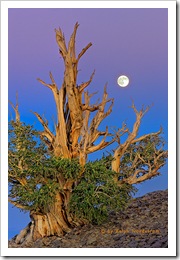
The first thing to deal with is the silhouette of the pint tree in the lower left hand corner.  I used the clone stamp tool to get rid of that.  I have no qualms about removing things that distract from the image.  But I draw the line at adding things.  Someone asked me if I added the moon in Bristlecone Moonrise.  No, I was there and that was the moon.  What’s the point of faking it.  The experience in the field would simply not be the same.  It’s so exciting to take an image like this and think you’ve got it.  But there’s always the nagging doubt in the back of your head wondering if you overlooked something and messed it up.   You never know until you get back at your computer to see what you really have.

bristlecone_moon_2008

But back to Yosemite.  So the pine tree silhouette had to go.  Also, I checked the image for dust spots and only found one or two.  The spot healing brush took care of them.

The next step was to do some local adjustments with Viveza.  It’s a cool tool from Nik Software that allows you to select an area and control brightness, contrast, saturation and more.  The clouds in the upper right needed contrast enhanced a little.  Next a couple of Curves with layer masks helped open up the valley floor even more.  I tried some vignetting on the bottom and really liked the way it funneled the eye into the center of the image where everything was happening.  I didn’t think I’d need any  vignetting for the top corners but tried it anyway and liked that too.

I made some global adjustments too.  Selective Color helped warm the reds with some yellow, lighten the yellows and darken the blues.  Color Balance also shifted the overall color just a couple points to the yellow.

Sorry I don’t have images of each of the steps along the way but that pretty much finished up the first evening.  The image was starting to get interesting and it was time to sleep on it and come back another day to take a fresh look at it.

Yosemite_1
Original Capture
Yosemite_Edit_1
After Photoshop Session 1

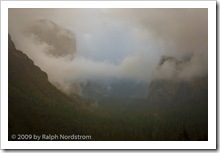
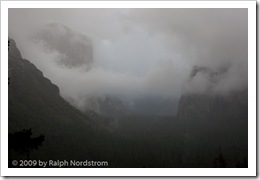
Here are the two side-by-side.  It’s starting to take shape.  There’s a little hint of warmth in the clouds and they stand out more from the background.  The valley floor is better defined and the trees stand out a bit more.  There’s actually a subtle feeling of warm light down there.  El Cap and Bridle Vail Falls also are more prominent and their warmer tones contrast more with the overall picture’s coolness.  You can click on the images to enlarge them.

Even before I fell asleep that night I was thinking of what needed to be done next.  As you work on an image you become satiated to the colors, tonalities and contrast and you can’t tell if they are good or not.  You also get emotionally involved.  So it’s good to stop, get away from it and return another day.  Sometimes when you return you are pleased and other times you say to yourself, “What was I thinking?”  When I get the latter reaction it usually means starting over from the beginning.  We’ll come back to this technique when you get far enough along to start making proofs.

So come back for #4 in this series to see if I  said, “What was I thinking?” or if I picked up from where I left off.

To see more of my photographs click here.

Join me on an upcoming workshop.

Become a fan on Facebook and follow along.

(1045)

The Making of a Photograph Part 2 – Exploration

In the first post I talked about photographing Yosemite Valley at sunrise from Tunnel View in a snow storm.  I imported the images into Lightroom and reviewed them there.  One stood out.  See The Making of a Photograph Part 1 – Selection.

Yosemite_1

The next step is to explore the image for possibilities.  I do this in Lightroom, making virtual copies of the image that I can then adjust.  I adjust such things as color temperature, exposure, highlights, shadows, fill, contrast, saturation, hue and more.  The goal is to see what’s in the image and what it’s capable of expressing.  I’m also looking for something that gets me excited.

Continue reading “The Making of a Photograph Part 2 – Exploration”

(1084)

The Making of a Photograph Part 1 – Selection

I spent a night in Yosemite Valley a few weeks ago.  See 24 Hours in Yosemite.  It was great to be back; no, it was fantastic to be back.  Both sunset and the following sunrise were shot from Tunnel View, the parking area just as you emerge from the tunnel on state highway 41.  You can always count on company, especially for sunset.

I’m working on one of the photographs taken there that weekend.  But before showing you the image, let’s start with some comments about the light.  Sunset was a near cloudless sky.  The only clouds were a few cotton balls floating over Half Dome.  The rest of the sky was clear.  As the sun set the shadows filled the valley, eventually claiming to the tops of the cliff faces.  But as they did beautiful warm light embraced the the mighty granite but gradually gave way to approaching night.

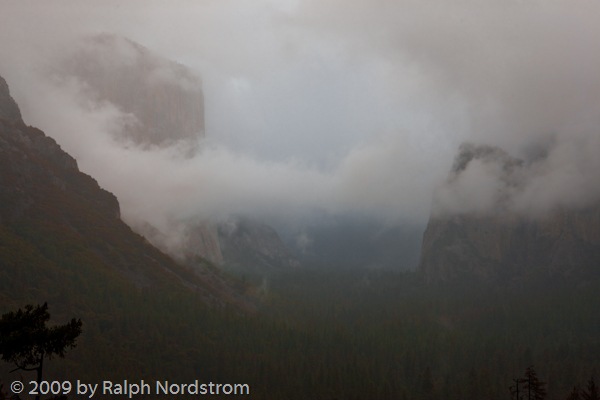
The morning was quite the opposite.  During the night the anticipated storm rolled in and rain started to fall.  The valley was now full of clouds swirling about, shrouding the eternal granite.  And snow flurries came, keeping all of us at Tunnel View on our toes, protecting our camera gear and warming our fingers.

It was an image from the morning shoot that I selected to work on.  There were long periods of waiting.  The snow flurries passed over us and moved on up the valley obscuring most or all of it.  Then they would pass but the clouds wouldn’t be in the right positions.  Eventually a wonderful, exciting light came shortly after sunrise, imparting a very faint warm cast to some of the clouds.  The rest of the scene was cool, both in light quality and air temperature.

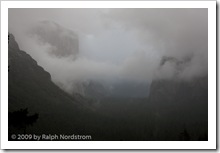
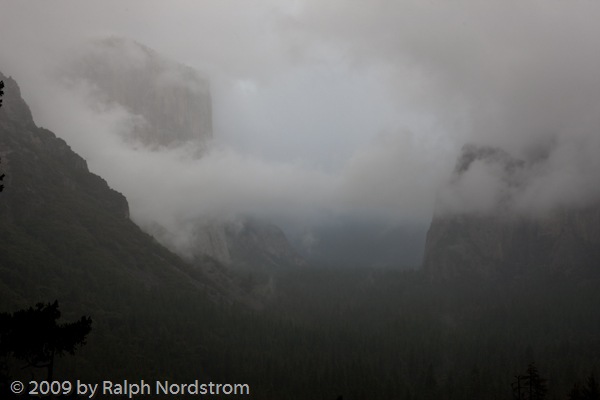
Yosemite_1This is the image I started from as it appears unaltered in Lightroom.  I selected it because of the sense of mystery created by the clouds that just give us glimpses of Bridle Vail Falls and the Cathedral Spires on the right and towering El Capitan on the left.  The hints of the beautiful warm hues in the clouds that I would try to pull from the image are present but not apparent in this image.  Rather, we see the predominantly cool mood.

Over the next several posts I’ll take you through the process of trying to recreate what I saw and felt that morning as well as what I discovered in this image.  There were some wonderful surprises in store.  So stay tuned.

The journey continues – read part 2.

To see more of my photographs click here.

Join me on an upcoming workshop.

Become a fan on Facebook and follow along.

(1096)

Exercising Your Creative Muscle

Describes an exercise to develop your eye for seeing compositions.

Remember when you first started driving?  Just about everything you did behind the wheel was a conscious act – steering into a curve, breaking for a red light, backing out of the garage, whatever.  Everything required a conscious effort.  But now, those things are all automatic and you can safely drive from point A to point B without even once thinking about the physical act of driving.  It’s a part of you.

If you learned to play a musical instrument you went through the same process.  I played piano and at first had to think about every key I pressed.  But as time went by it wasn’t which key needed to be pressed any more but how to interpret the phrase.  The fingers automatically went to where they were supposed to go.

Athletes also experience the same thing.  For example a tennis player at first needs to concentrate on every part of a backhand swing or a serve.  But after a while it it all becomes muscle memory.

The single most important thing that causes this effect to happen is frequent practice, usually daily.

But what does this have to do with photography?  Well, this applies on two levels and I’m specifically referring to photography in the field.  The first is the operation of our instrument, our camera.  At first things such as exposure, focus, depth of field, filtration, etc. are all conscious acts.  And this doesn’t touch on all the additional functionality modern digital cameras provide such as highlight tone priority, high ISO noise reduction and on and on.

Continue reading “Exercising Your Creative Muscle”

(608)

Arriving after the Light is Gone

Some photographers don’t seem to understand that the good light in the morning is BEFORE the sun comes up, not an hour or two after.

How often do I see people arriving at a great site about the time I’m packing up and heading back?  It happened again this morning.  I was photographing the West Temple and Alter of Sacrifice from half way up the tunnel road.  Granted, I get to a site a little on the early side.  The 45 minutes before sunrise rule gets stretched a little.  I like to arrive while the stars are still out.  Why?  I just like the quite time.

Continue reading “Arriving after the Light is Gone”

(1086)

A New Lightroom Technique

Explains a Lightroom technique for dealing with difficult lighting conditions, especially with those associated with dawn and twilight.

I love the time in the morning when the eastern sky just begins to show the first hint of the dawn.  The world goes through an amazing transformation up until the sun peeks over the horizon and begins its march across the sky.

My camera and I are very active during that time but I have precious little to show for all the gigabytes of images we’ve captured.  That’s not to say I haven’t tried really hard.  But none have turned out to my satisfaction.  They all seem so heavy-handed and certainly don’t capture the serenity of the moment.

Well, I had an idea today.  It goes back to something I experimented with a couple of years ago and couldn’t get to work.  The basic idea is to work in black and white first and later restore the color.  The thought behind this is to get the tonalities right first without the distraction of color.

What I am about to describe is done in Lightroom and doesn’t use any of the local adjustment features of LR 2.

So, my first approach was to set the image to Grayscale in the Treatment area of the Basic control group in LR.  I wasn’t after anything fancy here, just to get the image into BW.  Next I adjusted tonality – black point, white point, contrast, etc.  In this step I was after a good looking BW image.  Next, back in the Treatment area I set the image back to color.  What I found was the color image was WAY over saturated.  Later I learned that was because I was working in RGB and not Lab.  So I tried Lab but never really got the hang if it.

Then today I had an idea.  I was working on an early morning photo from last month’s Grand Canyon trip and wasn’t happy with the way this one was turning out either.  So I fired up LR again and selected the image I had been working on.  Let me walk you through the process.  It’s the same idea but executed in a much more controlled manner.

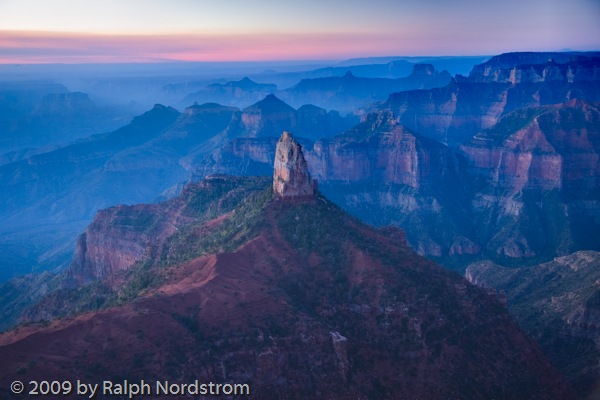
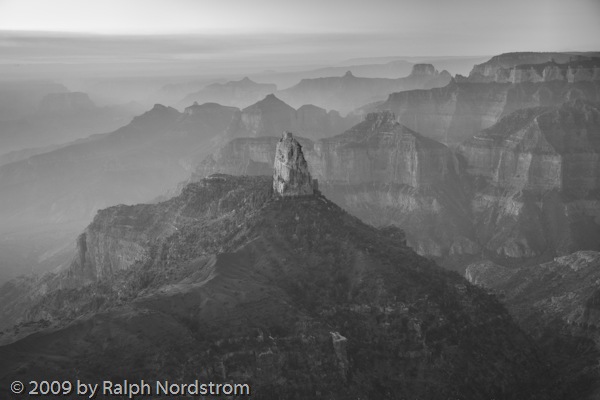
Here’s the starting image.  Actually, due to the extreme dynamic range, this is an HDR image.  But this was the starting point.  There’s lots of atmosphere in this image.  And a lot of blue.  You would expect it to be cool because the main source of light is the blue sky.  I like the sense of atmosphere but I’d like to moderate the blue, bring some warmth into the rocks and maybe a little more definition to the cliffs in the middle ground. _A1P1372_0_1_fused-1 The first step is to render the image to black and white.  But instead of using the Grayscale feature, I turned to the HSL control.  You can render colors in gray scale by reducing their saturation.  So I selected Saturation and set the slider for each color to zero.  The result is a BW image.

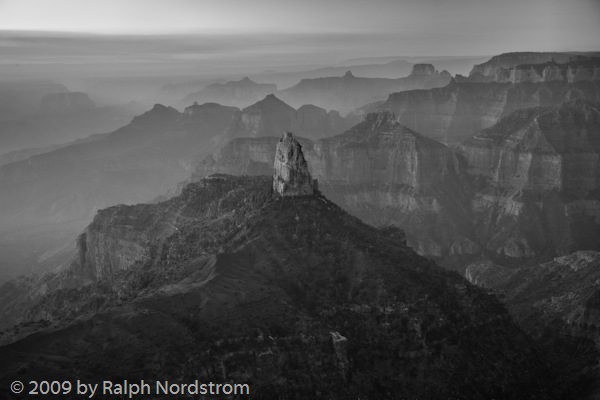
_A1P1372_0_1_fused-2 It looks good this way.  There is still lots of atmosphere in the distant haze.  But I’d like to try to get a little more contrast in the middle ground cliffs without loosing the hazy feeling.  And I’d like to open up the dark area in the center and bottom a bit.  A little playing around with the Basic controls yielded the  following.

_A1P1372_0_1_fused-3 In this example the differences are pretty subtle but can be seen when you enlarge the two images.

The next step is to reintroduce color by increasing the saturation one color at a time.  The nice thing about this process is that it turns out to be easier to add color than to try to take it away.  You can always add a little of one color, them some of another and jump back and forth until you get close to the effect you want.  So after a few minutes this is what emerged.

_A1P1372_0_1_fused-4The image is still cool but it’s not the overwhelming blue of the original.  The foreground has a lot more detail and is much more to my liking.  The middle ground has a bit more definition because of the adjustments in the tonality we made in the last step and the reduced intensity of the blue.

But it’s still too blue.  The image would be strengthened if there were some contrasting colors.  It doesn’t have to slap you in the face; there just needs to be some soft oranges and yellows to complement the blues.  This will add a lot of visual interest to the image.  To do that I turned to Color Temperature.  Increasing the color temperature (shifting the color balance to the yellow) produced this image.

_A1P1372_0_1_fused-5This change produced a very pleasant surprise.  By adding yellow the spire in the center of he picture separated itself from the blue background and the image became much  more three dimensional.  The effect is subtle but very real.

One final change is needed.  The sky in the upper left hand corner is very close to being blown out and very distracting.  I tried several things to darken it, desaturate it and the like.  I considered waiting until I got the image into Photoshop to deal with it.  But then I decided to crop it out.  The sky isn’t needed to make this image work.  It’s really the rows of receding ridges reaching above the blue haze that gives this image its impact.  So out came the crop tool.

_A1P1372_0_1_fused-6 This is much more pleasant than what I’ve been able to come up with over the past several weeks.  I’ll sleep on this and return to it another day.  I find that I get caught up in what I’m trying to do and when I see it a day or two later I often wonder what I was thinking.  So there may be some more adjustments in Lightroom but it’s very close to being ready to import into Photoshop for the fine tuning.

To make the before and after comparison easier, here they are side-by-side.

_A1P1372_0_1_fused-1 _A1P1372_0_1_fused-6

We conduct photography workshops.  Click here to check them  out.

To see more of my work visit http://RalphNordstromPhotography.com

Finally, we invite you to join us on Facebook and become a fan.

(671)

Default Camera Configuration

When I’m out shooting I often make adjustments to my camera settings to get the right shot.  The problem is it’s easy to forget what you’ve done.  Then the next time you grab your camera and start shooing you might miss the shot because something is configured wrong.  So I have this routine I go through in the hotel room every night.

Riverside_Walk_2008

First, I clean everything.  I carry a soft cotton dish towel in my camera bag.  First I wipe down the camera body and all the lenses.  I try to not only wipe off the surfaces but all the nooks and crannies.  I’m very careful not to damage anything.

Next I check the front and back elements of each of the lenses to make sure they are spotless and dust free.  The front element will get blown off first.  I prefer the Giotto Tornado as it’s designed specifically for cameras.  If that doesn’t get everything I’ll use a microfiber lens cleaning cloth.  As a last resort I’ll use a lens cleaning solution.  The best way to do wet cleaning is to put a drop or two on the microfiber cloth, not on the lens element.  The back element gets blown off.  It usually doesn’t need any more than that because it isn’t exposed to the elements near as much as the front element.

I also check my filters, making sure they too are spotless.  I use the same procedure that I use for cleaning the lens elements.

Next I clean the camera sensor.  Again, I blow it off first using the Giotto Tornado.  I remove the lens, pop the mirror out of the way using the camera’s manual clean function and hold the body with the opening pointing down.  I’m really careful how hard I blow on the sensor.  I prefer to use puffs of air, not a tornado blast like the name suggests.  The last thing I want is some microscopic particle of sand to get embedded in the sensor’s filter.

I have a loupe from the Visible Dust people that lets me look at the sensor under magnification.  Its six LCD lights really light it up and if you  look carefully you can see dust and stains.

If there’s still dust that the Giotto didn’t get rid of the next step is to use Visible Dust’s Arctic Butterfly.  You charge the bristles with static electricity by spinning the brush with the built-in motor in the handle.  The static charge is usually enough to remove any clinging  bits of dust.  If that doesn’t work then wet cleaning is necessary.  I’d rather not get into that here.

Once the camera body, sensor and lenses are all cleaned there’s one last step.  I set the configuration of all my camera controls to their default settings.  These are the setting I shoot with most often.  We probably all configure our cameras somewhat differently but  here are my default settings (I have a Canon 1Ds Mark III so some of these settings may be specific to Canon).

  • Lenses – set to auto exposure.  Turn image stabilization (vibration reduction for Nikons) on of the lens has it.
  • Exposure – Aperture priority
  • Exposure compensation – 0 stops
  • ISO – 100
  • Metering – Evaluative
  • Drive – Single shot
  • Auto-focus – One shot
  • Exposure bracketing – 0 stops (off)
  • Highlight tone priority – off
  • Number of bracketed shots – 3
  • High ISO speed noise reduction – off
  • Mirror lockup – off
  • White balance – Automatic
  • File format – RAW

One of the nice features my camera has is a ‘My Menu’ in which I have put the menu options I use most frequently.  This makes resetting the camera to its default configuration much simpler as there’s just one place to go in the labyrinth of menu options.  (It also makes it a lot easier to change options in the field.)

The other part of the nightly ritual is to backup memory cards, preferably in two places.  If I only have one backup I’ll refrain from reformatting the card until I get home.  But if I can make two copies I’ll reformat the card.

Oh yes, there are always a lot of batteries to recharge – camera, laptop, external drive, cell phone, GPS,….  (Hint: I carry a power strip with me because there are never enough available sockets in a hotel room.)  After all that, it’s time to get some sleep because sunrise is coming quickly.

To check out our workshops click here.

To check out our photographs click here.

To join us on Facebook click here.

(784)