The Same Ol’ Question

Even Ansel Adams was critisized for ‘manipulating’ his photographs.

Every time I do a show I get asked multiple times if my photographs are manipulated.  My answer is always, ‘Yes, of course.’  The hidden expectation is that photographs are supposed to be accurate depictions of the scene that is photographed.  This expectation is not new.  And any photographer that seeks to make art rather than documentation must face this question.

Take Ansel Adams for instance….
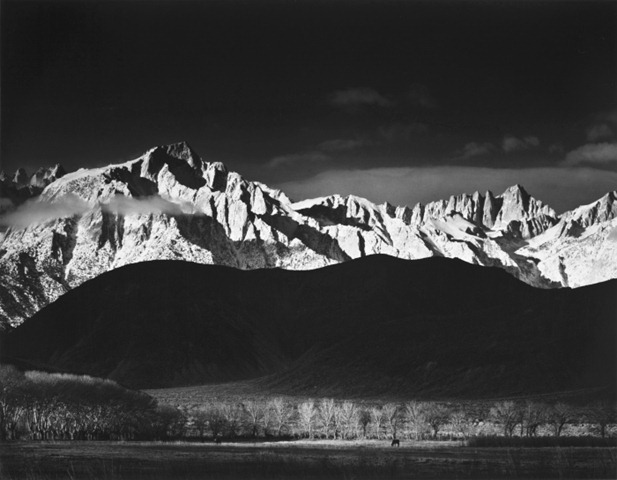
ansel_adams_winter_sunrise

The above iconic Ansel Adams photograph is titled Winter Sunrise.  It is of Mt Whitney and Lone Pine Peak above the Alabama Hills with Adams’ characteristic dramatic lighting.

There’s an interesting excerpt regarding this photograph from his book, “Examples, The Making of 40 Photographs.”

“The enterprising youth of the Lone Pine High School had climbed the rocky slopes of the Alabama Hills and whitewashed a huge white L P for the world to see.  It is a hideous and insulting scar on one of the great vista of our land, and shows in every photograph made of the area.  I ruthlessly removed what I could of the L P from the negative (in the left-hand hill), and have always spotted out any remaining trace in the print.  I have been criticized by some for doing this, but I am not enough of a purist to perpetuate the scar and thereby destroy – for me, at least – the extraordinary beauty and perfection of this scene.”

It seems the debate raged in Adams’ day and continues today.  I guess you know where I stand.  Oh, and for those ‘purists’ that revere Adams, if they only knew.

Winking smile

Go ahead.  Express yourself in your photographs.

Join me on an upcoming workshop.  Click here for more details.

To see more of my photographs click here.

(1565)

Mastering Exposure–Histograms Part 4

Learn more about histograms. We explore the histogram that results from low contrast scenes – how to capture it and what can be done with it in post processing.

In this series of articles we’ve been exploring the histogram.  In the first two articles we discussed what it is.  Now we’re looking at different types of histograms and exploring how to work with them both in the field and during the post processing.  If you want to review or catch up, here are the links to the preceding three posts.

Mastering Exposure – Histograms Part 1: Introduction

Mastering Exposure – Histograms Part 2:  A Closer Look

Mastering Exposure – Histograms Part 3: The Rocky Mountain Histogram

In this article I want to discuss my favorite histogram, the Mole Hill histogram.  I like this one because so much can be done with it in the post processing.  Subtle colors and tonalities can be revealed in soft radiant light.  It lends itself to some of the most creative and expressive images.

Read on and we’ll look at what it is, the conditions in which it occurs, how to photograph it and how to work with it in the post processing to reveal the scene in all of its hidden glory.

Continue reading “Mastering Exposure–Histograms Part 4”

(4763)

Photography Tutorial–Composition

Using design elements in landscape photography

Why study composition?  Edward Weston said, and I paraphrase, that studying the laws of composition before taking a photograph is like studying the laws of gravity before going for a walk.

Well, sometimes I feel like a toddler when it comes to composition.  And if you’ve been around a toddler as they’re learning to walk you know how diligently they study the laws of gravity and why they have such thick padding on their rumps.  There’s a reason they’re called ‘toddlers.’

I’m always searching for new ways to present the principles of composition in my photography workshops.  And I think I’ve come up with an approach that will get some of the people seeing the world differently, at least that’s the goal.  I like to challenge my workshop attendees to stretch themselves and expand the way they see.

Continue reading “Photography Tutorial–Composition”

(1244)