Photographing the Eastern Sierra

Let me show you some of my favoriate locations for photography in the Eastern Sierra.

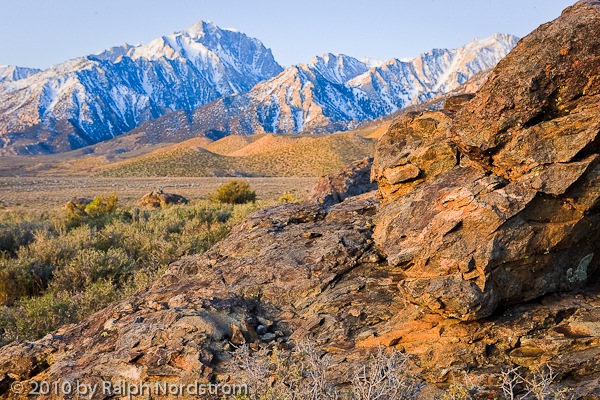
I don’t know where you’ll find a more spectacular range of mountains than the eastern edge of the mighty Sierra Nevada Mountains.    This is where the gargantuan slab of granite from which the mountain range is formed plunges precipitously from the peaks along the crest into the Owens Valley below.  Driving up the Valley on legendary highway US 395 is likely to give you a crick in your neck.  Because you can’t take your eyes off the endless procession of towering summits.
I’ve camped and backpacked in these mountains since I was a young boy and I always love returning to them.  And now that I come back with camera in hand I have an opportunity to capture and share with you the inspiration I receive here.
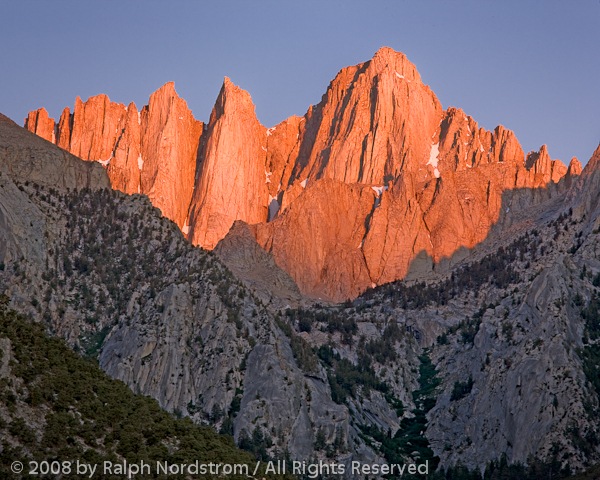
mt_whitney_first_light_2009_rrpm_rc100
Mt Whitney
mt_williamson_2010_rrpm_rc50
Mt Williamson
Mt Whitney is the tallest peak in the lower 48 and from your vantage point in the valley below it towers more than two vertical miles above your head.  It’s nothing short of breathtaking in the morning sun.
But there’s more to the Eastern Sierra than the grandeur of these mighty peaks.  Come with me on a journey as I show you the superlative and the sublime.

(1970)
Preparing Photographs–Printing, Matting and Framing

Here’s an outline of how I prepare photographs to display and sell.

I’ve been printing, matting and framing for the past several days ,getting ready for the first shows of 2011.  I have a lot of new photographs so this is both a busy and an exciting time.

It occurred to me that I went through a lot of trial and error  when I first started this process of preparing photographs to display and sell, and that it just might be helpful to some if I shared the system I finally worked out.

Continue reading “Preparing Photographs–Printing, Matting and Framing”

(1669)

Dewitt Jones Said It All

I was reading an article by Dewitt Jones in the latest Outdoor Photographer last night.  I always enjoy reading him; he is so positive and full of enthusiasm.  The title of the article was Don’t Prove…Improve!  He was recounting his experience when he got hired on as a National Geographic Photographer.  Dewitt was a little intimidated.  His new boss, Bob Gilka, gave him some advice that applies to us all.  He told Dewitt, “You don’t have to prove yourself, not to me or to the other photographers.  What I do demand that you do is improve yourself.  Every day….”

Dewitt goes on to write,

“[Gilka] understood that when we shoot from our own unique vision, there’s no reason to ‘prove’ ourselves…. There’s only one person on the planet who can do what we do, see as we see.

“Improve ourself?  That’s a different story.  There’s so much for all of us to learn to make our vision clearer, stronger, sharper.  And Gilka knew that the fastest way to learn is to trust and share rather than compete.”

Yep, I always enjoy reading Dewitt’s comments.  He is so positive.  And right on.

(990)

Backup Your Photos

Presenting a solution for backing up your iimportant photo files while also being able to share them between computers.

Some time ago I thought I had lost a year’s worth of RAW files.  I was using Photoshop Bridge which I rarely  use (I use Lightroom to manage my photos) and it had inadvertently moved the folder when I thought the folder was deleted.  It took a couple of days to find copies of all the supposedly deleted files, only to find a week or so later that they were all still there, just in a different location.

That launched an ongoing effort to come up with a better backup strategy.  The solution is still evolving but it’s to a point where it’s worth sharing with you.

Continue reading “Backup Your Photos”

(1831)

Art is Communication

Art is communication and slowing down can help us communicate more effectively.

I love flickr.  It’s arguably the best photo sharing site for photographers.  I get to see some really good, inspiring work from the other photographers I follow.

And, like most photo sharing sites, you can add comments.  When I post photographs I always look forward to receiving feedback and encourage anyone who visits my page on flickr to leave copious comments, both complements and criticisms.   If you haven’t visited yet, here’s the link.

http://www.flickr.com/photos/ralphnordstromphotography/

Continue reading “Art is Communication”

(906)

The Making of a Photograph–Watchman Tower

An example of how to process a difficult capture.

I was working on a photograph last night that turned out rather well. It was taken during a recent photography workshop in Zion National Park in Utah. I took the group to the famous bridge to photograph the Virgin River and the Watchman Tower at sunset. It’s a must photograph. It seems every photographer in Zion with a tripod is there. But we also returned for sunrise and had the bridge to ourselves.

There is a time of day when exposure becomes very tricky. This is during twilight when the sun is a little below the horizon so the earth is dark but the sky is very bright. You end up with what I call the “Grand Canyon” histogram – there’s a huge spike at the shadow end and a similar spike at the highlight end with a large gap in between. This is a challenging situation that, if you master, can provide some spectacular images. In this blog I’d like to walk you through the process.

Continue reading “The Making of a Photograph–Watchman Tower”

(1826)

Creative Vocabulary

Art is communication and each art form has a vocabulary, the creative vocabulary. Explore the creative vocabulary of photography and discover how being aware of it can help you grow and develop as an artist.

We all communicate with each other.  In our every day dealings we use our verbal vocabulary.  But as artists we also communicate, this time through our medium.  And for this we have another vocabulary, our Creative Vocabulary.

Let’s take a closer look.

Continue reading “Creative Vocabulary”

(1321)

Photographic Challenges – the Situation

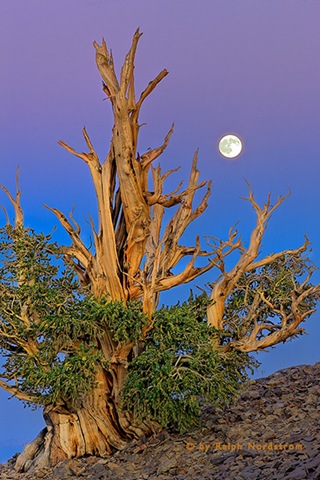
It was about two years ago that I was making plans for a very special photograph.  The concept was to photograph a bristlecone pine with the full moon rising behind it.  I also wanted the full moon in the earth shadow.  That’s the band of pink that rises in the east as the sun sets in the west.  Above the earth shadow the sky is a light blue.  In the shadow it’s a much darker blue.  And in the band between light and dark is a spectrum of colors, much like what happens in the west but more subtle.

Photographic Situation

Timing was going to be critical.  I needed to pick the right day of the month so that the moon would be in the earth shadow.  Too early and the moon would be too high when the shadow appeared.  Too late and the moon would rise well after the shadow was gone.

bristlecone_moon_2008 Bristlecone Moon (2008)

Continue reading “Photographic Challenges – the Situation”

(1092)

Cliché

Cliché, to many photographers this is a dirty word.  Photographs of Yosemite Valley from Tunnel View, the Tetons from Ox Bow Bend, the Watchman in Zion from the bridge, Delicate Arch – all are considered by many to be clichés.

What exactly is a cliché?  Something that has lost its originality, ingenuity, impact from long overuse.  In other words, it’s been done before – and many times.  Some have gone so far as to suggest that there are no photographs left in Yosemite Valley that are not clichés.

Not all of us agree.

Continue reading “Cliché”

(733)

Photography Tutorial – Getting the Shot

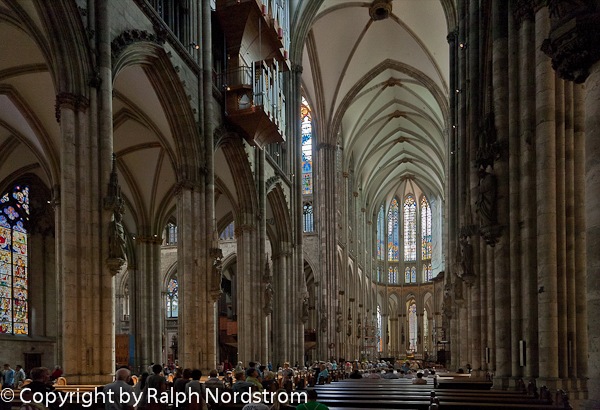
Last week I published a post in which I presented a photographic situation and solicited input on what decisions might go into getting the shot.  The situation was to photograph the interior of the beautiful Cologne Cathedral in Germany.  Here’s a link to the post.

Getting the Shot – Cologne Cathedral

In this post I’d like to share what was going through my mind as I prepared to push the shutter.  For starters, here’s the final photograph (click the photograph to enlarge it).

_A1P6721-Edit Cologne Cathedral

You may recall from the original post that I spoke of two things that go into every work of art – the artists Creative Vocabulary and the Interpretive Decisions he or she makes.

In this instance, which focused on the technical aspects of getting the shot, the Creative Vocabulary consists of the capabilities of the camera and the knowledge to use them.  The Interpretive Decisions are those decisions made in the moments that lead up to the instant the shutter is pressed.  So let’s step through what was going through my mind as I prepared to capture this image.

Continue reading “Photography Tutorial – Getting the Shot”

(1147)