Why HDR?

Many photographers think HDR is a bad thing and avoid it like the plague. But it’s harmless and can be useful. Read on….

Why HDR?

For many photographers, the term HDR is associated with a style of photography that is rather absurd – the grunge look.  I’ve heard experienced photographers say they don’t use HDR because they don’t like the results.  When the beta version of Photomatix, a product created by HDRsoft, made its debut on November 20, 2008, it automated a manual process that landscape photographers were using at the time.  Occasionally, they would encounter situations where the dynamic range of the scene they wanted to photograph was greater than what the dynamic range their camera’s sensor could capture.  So, they took two shots at different exposures that, when put together, covered the whole dynamic range of the scene.  Then they stacked the two images in Photoshop and created masks to expose the highlights from the underexposed image and the shadows from the overexposed image.  The final result was an image that captured the full dynamic range of the scene.  Photomatix simplified this process by doing the blending.  But instead of blending just two images Photomatix could blend three, four or even five images.

Photomatix also gave the photographer a choice on several different ways of blending the images.  Grunge was just one of them and it took off like wildfire.  There were a few grunge photos that were excellent, but most were mediocre at best.  For many people, HDR became associated with the grunge look which gave it its bad name, and it became poor taste to shoot HDR.

But dealing with dynamic ranges in a scene that exceeds the technologies of the day wasn’t new.  It goes back to the beginning of photography in the 1860s.  After all, all cameras so far have a limit to the dynamic range they can capture whether they use Daguerreotypes, wet plates, dry plates, film or digital.

Continue reading “Why HDR?”

(114)

Taking Your Photography to the Next Level

Our art, photography, can be a rich and rewarding endeavor and an ever fascinating journey of self-discovery. Be open to the possibilities and hone your skills. Become really good at what you do best.

“Did you manipulate your photograph?”  “Did you use a filter?”  “Do you use a Mac?” “Do you crop your images?” “I’ll have a nicer day than you; I’m not shooting a Canon.”  Yes, someone actually said that to me at Bridal Vale Falls in the Columbia River Gorge of Oregon in response to my cheery, “Have a nice day.”  I guess when you take the entire population of photographers you will always find those that are prejudiced and closed minded just like any other population.  They think they are right and anyone that disagrees with them is wrong.  It’s that simple.

The current issue of Lenswork magazine, the premier journal for black and white photography, has an article by guest contributor Jim Kasson titled “Previsualization in the Digital Age.”  I couldn’t wait to read it.  In my workshops and lectures I’ve always advocated that an artist interprets reality and communicates that interpretation through her or his art.  In landscape photography I’ve encouraged our workshop attendees to leave their camera gear in the car until they connect with a location and only then set up their cameras to try to capture what is is they are experiencing.  Previsualization, the anticipation of what the finished work will look like, is a big part of communicating what you are feeling.

Continue reading “Taking Your Photography to the Next Level”

(4547)

The Same Ol’ Question

Even Ansel Adams was critisized for ‘manipulating’ his photographs.

Every time I do a show I get asked multiple times if my photographs are manipulated.  My answer is always, ‘Yes, of course.’  The hidden expectation is that photographs are supposed to be accurate depictions of the scene that is photographed.  This expectation is not new.  And any photographer that seeks to make art rather than documentation must face this question.

Take Ansel Adams for instance….

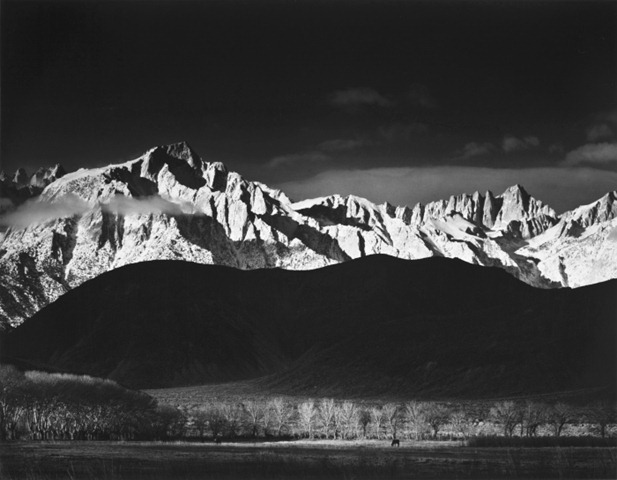
ansel_adams_winter_sunrise

The above iconic Ansel Adams photograph is titled Winter Sunrise.  It is of Mt Whitney and Lone Pine Peak above the Alabama Hills with Adams’ characteristic dramatic lighting.

There’s an interesting excerpt regarding this photograph from his book, “Examples, The Making of 40 Photographs.”

“The enterprising youth of the Lone Pine High School had climbed the rocky slopes of the Alabama Hills and whitewashed a huge white L P for the world to see.  It is a hideous and insulting scar on one of the great vista of our land, and shows in every photograph made of the area.  I ruthlessly removed what I could of the L P from the negative (in the left-hand hill), and have always spotted out any remaining trace in the print.  I have been criticized by some for doing this, but I am not enough of a purist to perpetuate the scar and thereby destroy – for me, at least – the extraordinary beauty and perfection of this scene.”

It seems the debate raged in Adams’ day and continues today.  I guess you know where I stand.  Oh, and for those ‘purists’ that revere Adams, if they only knew.

Winking smile

Go ahead.  Express yourself in your photographs.

Join me on an upcoming workshop.  Click here for more details.

To see more of my photographs click here.

(1565)

Journey – First Steps

Introducing “Journey – First Steps,” a showcase of 24 photographs from Ralph Nordstrom and a chronicling of his discoveries in photography over the past five years.

I’m very excited to announce that I just published my first book.  It’s something I’ve been thinking about for along time.  The title is “Journey – First Steps” and it showcases 24 of my favorite photographs from 2005 up into 2010.  It’s also a chronicle of my development as a photographer from those early uncertain days to today.  Not only does the book contain these photographs but I share with you where I was at the time they were taken and the discoveries I made along the way.

Your are invited to check out the preview.  It contains a sampling of the 54 pages and is available in eBook format (viewable on iPad and iPhone), soft cover and hard cover on Blurb.  It would make a beautiful gift for someone dear.

Oh, and let me know what you think.  Thanks.

We do photography workshops.  Come on out and join us.  Click here to check us out.

You can also check out our photography.  Click here.

(711)

What Else Things Are

What do your photographs say – about the things you photograph and about you? What do your photographs trigger in your viewers’ minds and imaginations?

Brooks Jensen published a very provocative article in the current issue of Lenswork.  He delves into a topic that I’ve thought about ever since I first picked up a digital camera.  It relates to the question of whether or not it is OK to manipulate photographs.  I’ve always contended that it is not only OK but, at least for the kind of photography I do, it is required.  The photographs I create reflect my interpretation of the natural world around us.  Therefore, their subjects and contents are going to reflect something of me.

Jensen goes several steps farther by identifying three major types of photography – Documentary, Personal Narrative and Imaginative.  Jensen describes Documentary photography as telling “someone else’s story.”  What a great way of describing it.  Clearly, then, in documentary photography, the photographer strives to be as true to the subject as possible and minimize or eliminate his or her own coloration or bias.  The goal is total objectivity.

Continue reading “What Else Things Are”

(977)

Orange County Fair Photography Judging

In this post I share with you what it’s like to be a photography judge at the Orange County Fair. It’s not that easy.

Over the years I’ve entered photographs into the Orange County Fair photography competition (with some success).  This year I was thinking about the photographs I wanted to enter when I was contacted by the folks at the fair.  They asked if I would be willing to be a judge.

Now, it’s an honor to have your photographs selected and an even greater honor when some of them receive ribbons.  But I think the greatest honor of all is to be invited to judge the competition.  But when I accepted I had no idea how tough it would be.

(For a followup post, please see

http://ralphnordstromphotography.com/wordpress/journal/orange-county-fair-judges-walkthrough/  )

Continue reading “Orange County Fair Photography Judging”

(1823)

2010 in Retrospect

Join me as I look back on the accomplishments of 2010 and look forward to the promise of 2011.

I feel kind of funny  writing this post. I’m feeling that this end-of-the-year, beginning-of-the-next band wagon is awfully crowded.  But it’s something I want to do, if for no other reason than to reflect on the year just passed and learn what I can apply to the new one just started.

As I’ve worked on my website over the past year and compared the work I’m doing these days to the works from four and five years ago I see definite signs of growth.  I’ve had many powerful influences over the years who I’ll not attempt to list here, except for my brother Roger.  One doesn’t learn photography in a vacuum.  While each of us is striving to find our own voice there is a long period of gestation where we are best served when we learn from and let ourselves be influenced by other photographers whom we respect and admire.  I feel that after five years there have been a few brief flashes of individuality where my personal style is just beginning to express itself.

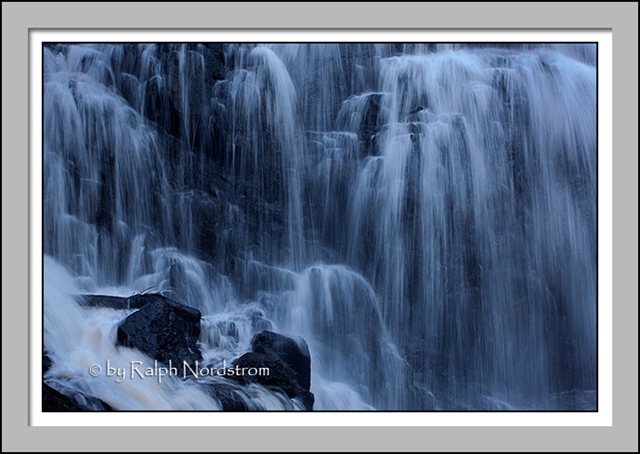
Partridge Falls

Continue reading “2010 in Retrospect”

(1117)

Art is Communication

Art is communication and slowing down can help us communicate more effectively.

I love flickr.  It’s arguably the best photo sharing site for photographers.  I get to see some really good, inspiring work from the other photographers I follow.

And, like most photo sharing sites, you can add comments.  When I post photographs I always look forward to receiving feedback and encourage anyone who visits my page on flickr to leave copious comments, both complements and criticisms.   If you haven’t visited yet, here’s the link.

http://www.flickr.com/photos/ralphnordstromphotography/

Continue reading “Art is Communication”

(906)

Honesty in Photography

I just read a great email from Brian Peterson, founder of The Perfect Picture School of Photography.  He ran an unscientific opinion pole on whether photographers felt it was OK to dramatically alter photographs in Photoshop.  Now, by ‘dramatically alter,’ Brian means to add major elements to an image that were not present in the original scene or make other major changes that alter the content of the image.

He has a provocative blog post with the title that starts, “Every photograph is a ‘lie,…’,  In it he raises the excellent point that even those photographs that aren’t altered in Photoshop are still an abstraction of reality and thus a ‘lie.’  I recommend you read it.

What were the results of his opinion pole?  Brian reports that 41% of photographers felt that it is OK to dramatically alter images in Photoshop and NOT tell anyone unless asked.  And if asked, some would say, “It’s none of your business.”  The reason photographers felt this way boiled down to two words – Artistic License.

I have my own thoughts on “artistic license” and would like to share them with you.

Continue reading “Honesty in Photography”

(1497)

Journey to a Fine Art Photograph Continued

In the first post (http://ralphnordstromphotography.com/wordpress/2008/02/18/journey-to-a-fine-art-photograph/)  I talked about the importance of the first step you take with your image, the opening move if you will.  I don’t know if this ever happens to you but it happens to me all the time – I work on an image for several evenings only to end up in a box canyon, a dead end.  It’s not going anywhere.  And so very often I think, “Wow, I started it all wrong.  I did X but if I had done Y I would have avoided this problem.”  It’s too bad but sometimes the weaker opening move isn’t manifested until you have quite a few hours invested in the image.  But the only thing to do, if you still believe in the image, is to start all over again.  Maybe you do so right away or maybe you set it aside for some weeks or months and just let it ferment in  your mind.

That leads to another ‘Ah Ha’.  Do you ever sit staring at an image and ask yourself, “What do I do next?”  Like I said before, I’m of the school that discovers the emotional content of an image as I work with it, not necessarily in the field when I’m shooting it.  “Discover” is the key word here.  Here’s the way it seems to me – it feels like walking across a meadow in a thick fog.  Sure, you can see one or two steps ahead but you can’t see the other side of the meadow until you get really close.

Each step you take is based on the one or two most obvious things you see when you look at the image.  Perhaps the first thing you notice is the need to address contrast.  You choose a tool to deal with it, say curves.  Once that’s corrected you see another thing, say color.  Maybe you choose selective color for that.  Next you see something else, perhaps a highlight that’s distracting from the overall composition.  You choose a tool to correct that, say dodge and burn.  And on you go, step by step, dealing each time with the most obvious correction that is calling out to you.

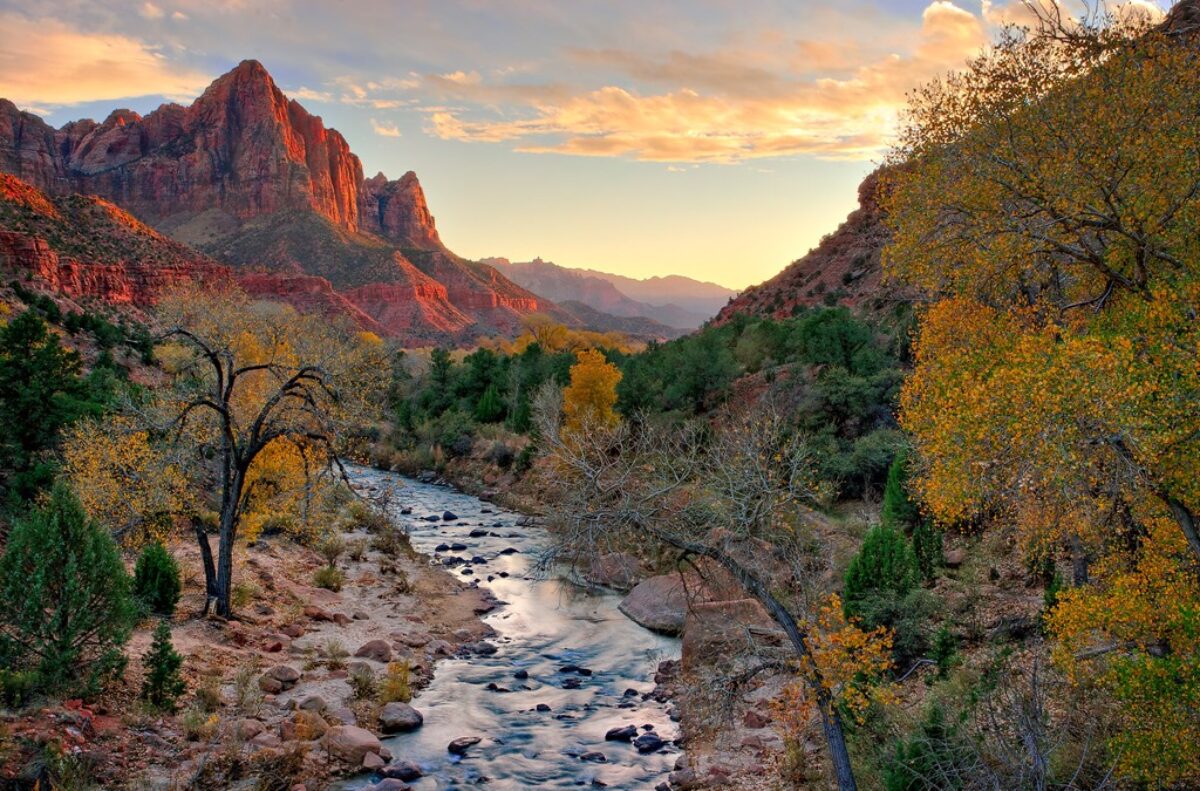
It’s in this process of picking our way across the creative meadow, through the fog, step by step that our personal style emerges.  Because, two artists looking at the same image on identical monitors will respond differently.  They may very well see different things calling out for attention.  And even if they see the same thing, the tools they choose to address them may be different.  And even if the tools are the same, the way in which they apply the tools will most surely be different.  And that’s just one step in the journey.  There are many, many more to go.  It’s fun listening to people who criticize us when we stand shoulder to shoulder with other photographers, cameras all pointed in the same direction, clicking away like mad.  They laugh about the individuality of artistic expression.  But of the two dozen or so photographers I shared the bridge with over the Virgin River shooting the Watchman in Zion this past Thanksgiving, I’ll lay odds that not a one of them has a photograph that looks anything like mine.  Not a one of them took the same path across the foggy meadow that I did.

The foggy meadow analogy also works to understand the importance of the first step you take with the image.  If it’s to the left, the right or straight ahead, you’ll end up in a different place on the other side.  You may end up in a place that you find inspiring or you may not.

The journey across the meadow can also be a journey of self discovery.  As you progress, the image takes on more meaning.  And as it does, you perhaps relate to the emerging meaning in ways that are new for you, ways that give you an insight into yourself, a deeper understanding of your inner self.  This in turn can lead toward exploring the image in yet different ways which can reveal new layers of meaning.  In this way, you and the image leap frog across the foggy meadow in a journey of understanding and self-actualization.

So, that a marvelous, miraculous and mysterious journey this is, from the field to the digital darkroom to eventually an expressive image hanging on the wall that carries so much of you, just as you carry the image and the journey that led you to it.

(408)